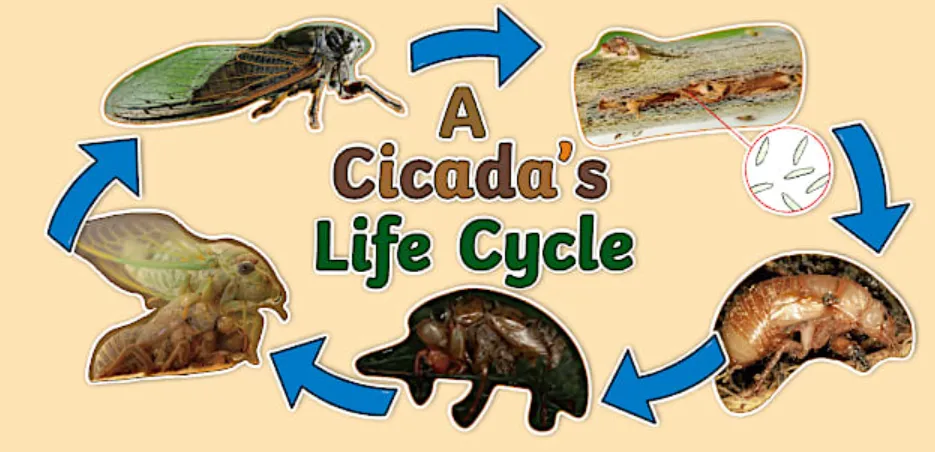
The life cycle of a cicada is one of the most fascinating insect life cycles in nature because most of it happens hidden underground. A cicada begins life as an egg placed inside a small slit in a tree branch. After hatching, the tiny nymph drops to the ground, burrows into the soil, and spends most of its life feeding from plant roots.
Unlike many insects that complete their life cycle in weeks or months, cicadas can stay underground for years. Many common “annual cicadas” appear every summer, but that does not always mean each lives only one year. Many species take several years to develop, while famous periodical cicadas emerge in synchronized 13-year or 17-year cycles. Smithsonian notes that adult periodical cicadas usually live only three to four weeks above ground after emergence.
Adult cicadas are best known for their loud sounds. Male cicadas produce calls using special sound organs called tymbals, mainly to attract females. There are about 3,000 cicada species worldwide, mostly found in warm, tree-rich environments.
Q: What are the main stages in the life cycle of a cicada?
A: The main stages are egg, nymph, molting/emergence, and adult cicada.
Q: How long does a cicada live?
A: Depending on the species, cicadas may live from a few years to 13 or 17 years, but the adult stage usually lasts only a few weeks.
Q: Do cicadas bite or harm humans?
A: Cicadas do not bite or sting people. They feed on plant fluids using piercing-sucking mouthparts.
Quick Life Cycle Table
| Stage | Where It Happens | What Happens | Approx. Time |
| Egg | Tree twigs/branches | Females lay eggs in small slits | About 6–7 weeks in the periodical cicadas |
| Young Nymph | Soil surface to underground | Hatchling drops and burrows into the soil | Begins immediately after hatching |
| Underground Nymph | Around plant roots | Feeds on root sap and molts several times | Several years, 13 or 17 years in the periodical species |
| Emerging Nymph | Soil surface/tree trunk | Climbs upward and sheds old skin | Usually, spring or early summer |
| Adult Cicada | Trees and shrubs | Sings, mates, lays eggs, then dies | Often 3–6 weeks |
The History of Their Scientific Naming, Evolution, and Origin
Scientific Naming of Cicada
The word cicada comes from Latin and is linked to the insect’s famous sound. In scientific classification, true cicadas belong mainly to the family Cicadidae. They are insects in the order Hemiptera, the same broad order that includes many sap-feeding insects.
Evolutionary Background
Cicadas have a very ancient evolutionary history. Modern cicada groups are linked to earlier cicadoid insects that developed specialized bodies for feeding on plant fluids and producing sound. A 2024 evolutionary study suggested that the families Cicadidae and Tettigarctidae may have diverged by the Middle Jurassic, showing that cicadas have deep prehistoric roots.
Origin and Natural Spread
Cicadas are now found across many temperate and tropical regions. Their success comes from their underground nymph stage, strong digging legs, tree-based reproduction, and sound-based mating system. Periodical cicadas are especially famous in North America because they emerge in huge synchronized broods every 13 or 17 years.

Their Reproductive Process, Giving Birth, And Rising Their Children
Cicadas Do Not Give Live Birth
Cicadas do not give birth like mammals. Instead, female cicadas reproduce by laying eggs. After mating, the female uses a sharp egg-laying organ called an ovipositor to cut small slits in tender tree twigs.
Mating Starts with Male Songs
The reproductive process begins when male cicadas produce loud calls. These calls help females identify males of the same species. In many species, several males call together, creating a loud chorus that can be heard from far away.
Egg Laying in Tree Branches
After mating, the female places eggs inside small branch cuts. This protects the eggs from many surface predators and keeps them in a suitable place until they hatch. In periodical cicadas, eggs commonly hatch after about six to seven weeks.
No Parental Care After Hatching
Cicadas do not raise their young directly. Once the eggs hatch, the tiny nymphs fall from the branch to the ground. They then dig into the soil and begin feeding from root fluids. Their “childhood” is independent and mostly hidden underground.
Survival Through Synchronization
For periodical cicadas, survival depends on mass emergence. Millions may appear together, overwhelming predators. This strategy is called predator satiation, meaning predators eat many cicadas but cannot eat them all.
Stages of the Life Cycle of a Cicada
1. Egg Stage
The egg stage begins when the female cicada deposits eggs inside tree twigs. She does not build a nest like a bird or a hive like a bee. Instead, the branch itself becomes the nursery.
The eggs remain protected inside the wood until the young nymphs are ready to hatch. This stage is shorter than the underground nymph stage.
2. Nymph Stage
After hatching, the tiny nymph drops to the ground and burrows into the soil. This is the longest and most important stage in the cicada life cycle.
Nymphs live near plant roots and feed on xylem sap, a watery fluid inside plants. They grow slowly and molt several times. Smithsonian Magazine notes that periodical cicada nymphs molt five times underground before becoming adults.
3. Molting and Emergence Stage
When fully developed, the nymph digs upward and creates an exit tunnel. It climbs onto a tree trunk, branch, fence, or plant stem.
Then it splits open its old outer skin, called an exoskeleton. The adult cicada pulls itself out, expands its wings, and waits for the body to harden. The empty shell left behind is called an exuvia.
4. Adult Stage
The adult stage is short but very active. Adult cicadas fly, sing, mate, and lay eggs. Male cicadas create loud calls with tymbals, while females respond and choose mates.
Important Things That You Need To Know
The keyword cicada can connect to several other search terms, but not all of them mean the same thing. Understanding these related terms helps avoid confusion.
A cicada is a real insect known for its loud mating call, underground nymph stage, and unusual life cycle. A cicada killer or cicada killer wasp is a different insect. It is a large solitary wasp that hunts cicadas and places them in underground nests for its larvae. Purdue Extension explains that cicada killers may look scary, but they are generally not aggressive unless directly handled.
The term covid 19 cicada variant or cicada COVID variant ba 3.2 does not refer to the insect. It refers to a nickname used in some reports for the SARS-CoV-2 lineage BA.3.2. ECDC listed BA.3.2 as a variant under monitoring, but this is a medical/public health topic with no biological connection to cicadas.
Another popular term is Cicada 3301. This is not an animal topic. It refers to an internet puzzle and cryptography mystery that became famous online between 2012 and 2014.
So, when studying the life cycle of a cicada, focus on the insect itself: its eggs, underground nymphs, emergence, adult songs, mating, and ecological role.
Their main diet, food sources, and collection process are explained
Main Diet of Cicadas
Cicadas feed mainly on plant fluids, especially xylem sap. Xylem is the watery tissue that helps plants move water and minerals from roots upward.
Nymphs feed underground from plant roots, while adults feed from twigs and stems. They do not chew leaves like caterpillars, nor do they collect pollen like bees.
Food Sources
Common food sources include:
- Tree roots
- Shrub roots
- Woody plant stems
- Young twigs
- Xylem fluid from host plants
Cicadas prefer areas with trees because trees provide both feeding sources and egg-laying sites.
How Cicadas Collect Food
Cicadas have a beak-like mouthpart called a rostrum. They insert it into plant tissue and drink fluid.
This feeding process is usually not highly destructive to healthy mature trees. However, egg-laying cuts may damage small twigs, especially on young trees.
Do Adult Cicadas Eat Much?
Adult cicadas can feed, but their main goal is reproduction. During the adult stage, they focus on calling, mating, and laying eggs before dying.

How long does the life cycle of a Cicada Live
- The total lifespan of a cicada depends strongly on the species.
- Many commonly seen cicadas are called annual cicadas, but this name can be misleading. It usually means that adults appear every year, not that each individual completes life in a single year.
- Some non-periodical cicadas may spend several years underground before emerging.
- Famous periodical cicadas live much longer. Some species emerge every 13 years, while others emerge every 17 years. USDA Forest Service explains that Brood XIII follows a 17-year cycle, while Brood XIX follows a 13-year cycle.
- The underground nymph stage is the longest part of the cicada life cycle. During this time, the insect feeds from roots, grows slowly, and molts several times.
- The adult stage is much shorter. Periodical cicada adults often live only three to four weeks after emerging.
- Some adult cicadas may survive for a few weeks longer, depending on species, weather, predators, and environmental conditions.
- Males may die soon after mating activity, while females usually live long enough to lay eggs.
- Predators such as birds, mammals, reptiles, spiders, and cicada killer wasps can shorten adult survival.
- Weather also matters. Heavy rain, strong winds, drought, extreme heat, or cold snaps can affect emergence and survival.
- A cicada’s life is therefore unusual: it spends years preparing underground, then only a short time above ground as a singing adult.
- In simple terms, the visible adult cicada is only the final chapter of a much longer hidden life.
Life Cycle of a Cicada Lifespan in the Wild vs. in Captivity
Lifespan in the Wild
In the wild, cicadas follow their natural rhythm. Eggs hatch in tree branches, nymphs burrow into soil, and adults emerge when soil temperature and seasonal conditions are suitable.
Wild cicadas have access to real tree roots, natural soil moisture, and proper emergence structures. This makes the wild environment the best place for completing their full life cycle.
Lifespan in Captivity
Cicadas are difficult to keep in captivity for a full life cycle. The main problem is the long underground nymph stage. A nymph may need years of access to living plant roots.
Adult cicadas also do not live long in enclosed spaces. They need room to fly, call, mate, and lay eggs in woody branches.
Which Is Better for Survival?
The wild is far better for cicadas. Captivity may be useful for short-term observation, but it is not suitable for maintaining their natural multi-year development unless managed under controlled conditions by researchers.
Importance of the Life Cycle of a Cicada in this Ecosystem
Food Source for Wildlife
Cicadas are an important seasonal food source. Birds, squirrels, raccoons, fish, reptiles, spiders, and insects may feed on them. During mass emergence, cicadas provide a major natural food pulse.
Soil Health and Aeration
Underground nymphs dig tunnels as they move through soil. These small tunnels can help soil aeration and water movement, especially around tree roots.
Nutrient Cycling
After adult cicadas die, their bodies decompose, returning nutrients to the soil. This supports microbes, plants, and other small organisms.
Tree and Forest Connection
Cicadas are closely connected with trees. They feed from root fluids as nymphs and lay eggs in branches as adults. Healthy tree systems help cicada populations survive.
Biodiversity Value
Cicadas are part of natural biodiversity. Their sounds, synchronized emergence, and predator-prey role make them important in many woodland and suburban ecosystems.
What to do to protect them in nature and save the system for the future
Protect Mature Trees
- Keep healthy mature trees, as cicadas need roots for feeding and branches for egg-laying.
- Avoid unnecessary tree removal in cicada habitats.
Reduce Pesticide Use
- Do not spray pesticides during cicada emergence unless there is a serious, confirmed pest problem.
- Cicadas are not dangerous to humans and usually do not require chemical control.
Protect Soil Quality
- Avoid compacting soil around tree roots.
- Healthy soil helps nymphs breathe, move, and feed underground.
Cover Young Trees Carefully
- If young trees are at risk, use fine netting during heavy cicada emergence.
- This protects tender branches without killing cicadas.
Support Natural Biodiversity
- Plant native trees and shrubs.
- Maintain mixed habitats that support birds, pollinators, soil organisms, and cicadas together.

Fun & Interesting Facts About the Life Cycle of a Cicada
- Cicadas spend most of their lives underground, not flying in trees.
- The loud cicada sound is made mostly by male cicadas.
- Cicadas use special sound organs called tymbals.
- The empty shell left on the tree bark is not a dead cicada; it is the old exoskeleton.
- Periodical cicadas can emerge after 13 or 17 years, making them among the longest-lived insects.
- Cicadas do not sting people.
- Cicadas are different from locusts. Locusts are grasshoppers, while cicadas are sap-feeding insects.
- A mass emergence helps cicadas survive because predators cannot eat them all.
- Some cicada calls can be extremely loud, especially when thousands sing together.
- Cicadas are symbols of rebirth in some cultures because they emerge from the ground and shed their old skin.
Frequently Asked Questions (FAQs)
Q: What is the life cycle of a cicada?
A: The life cycle of a cicada includes egg, nymph, molting/emergence, and adult stages. Most of the life cycle happens underground during the nymph stage.
Q: How long do cicadas stay underground?
A: It depends on the species. Some cicadas stay underground for several years, while periodical cicadas stay underground for 13 or 17 years.
Q: What do cicadas eat?
A: Cicadas feed on xylem sap, a watery plant fluid. Nymphs feed from roots, and adults feed from stems or twigs.
Q: Are cicadas harmful to humans?
A: No. Cicadas do not sting or bite humans. They may be noisy, but they are not dangerous.
Q: What is the difference between a cicada and a cicada killer wasp?
A: A cicada is a sap-feeding insect, while a cicada killer wasp is a solitary wasp that hunts cicadas. They are completely different insects.
Conclusion
The life cycle of a cicada is a powerful example of nature’s patience, timing, and survival strategy. From eggs hidden in tree branches to nymphs living underground for years, cicadas spend most of their lives out of sight. Their short adult stage is focused on singing, mating, laying eggs, and continuing the next generation.
Cicadas are more than noisy summer insects. They support wildlife, improve soil activity, recycle nutrients, and add biodiversity to forests, gardens, and urban landscapes. Their unusual 13- and 17-year cycles also make them among the most remarkable insects on Earth.
Protecting cicadas means protecting trees, soil, and balanced ecosystems. When we understand their life cycle, we see that cicadas are not pests to fear but important natural creatures with a unique role in the environment.
Also Read: life cycle of a sunflower
About the Author