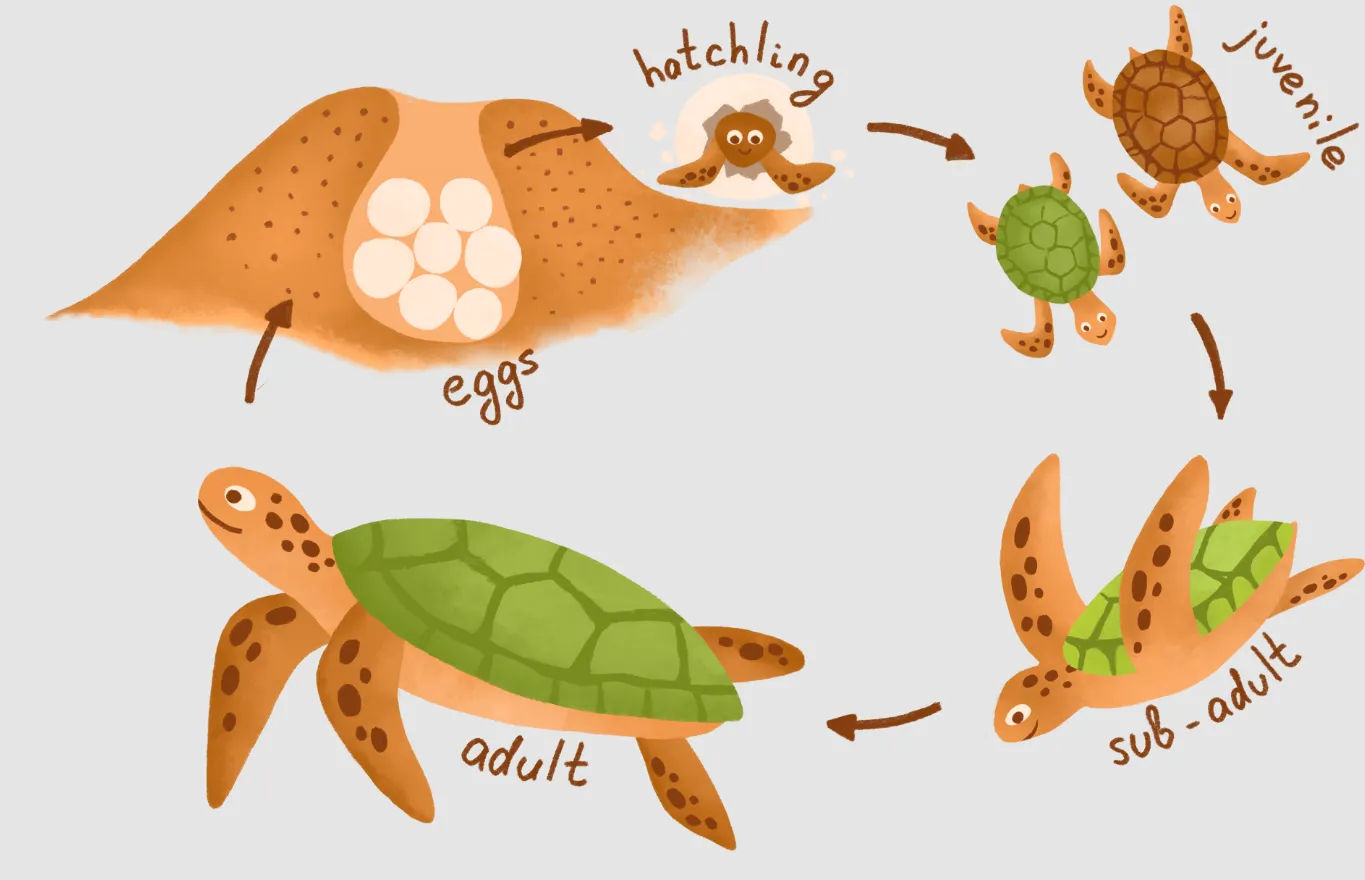
The life cycle of a sea turtle is one of the most fascinating journeys in the marine world. A sea turtle begins life inside a soft-shelled egg buried under warm beach sand, breaks out as a tiny hatchling, runs toward the ocean, survives years in open water, grows into a juvenile, and finally becomes a mature adult capable of returning to nesting beaches.
This journey is long, dangerous, and deeply connected to ocean health. Sea turtles are ancient marine reptiles that spend most of their lives in the ocean, but adult females return to land to lay eggs.
Well-known species include the green sea turtle, leatherback sea turtle, hawksbill sea turtle, and loggerhead sea turtle. Each species has a slightly different lifestyle, diet, migration pattern, and ecological role.
Q: What are the main stages in the life cycle of a sea turtle?
A: The main stages are egg, hatchling, oceanic juvenile, coastal juvenile, subadult, and adult breeding turtle.
Q: How long does it take for a sea turtle to become an adult?
A: Many sea turtles take around 15 to 30 years to reach reproductive maturity, depending on the species and environmental conditions.
Q: Why do female sea turtles return to beaches?
A: Female sea turtles return to sandy nesting beaches to lay eggs. Many females return to the same general region where they were born, a behaviour known as natal homing.
Quick Life Cycle Table
| Life Stage | What Happens | Main Habitat | Main Risk |
| Egg | A female lays eggs in a nest under the sand | Tropical or subtropical beach | Predators, flooding, heat, and human disturbance |
| Hatchling | Baby turtles break out and crawl to the sea | Nesting beach and surf zone | Birds, crabs, fish, and artificial lights |
| Oceanic Juvenile | Young turtles drift and feed in the open ocean | Floating seaweed zones and pelagic waters | Predators, plastic, bycatch |
| Coastal Juvenile | Turtles move to feeding grounds | Seagrass beds, reefs, bays, and coastal waters | Boat strikes, fishing gear, and pollution |
| Subadult | The body grows larger and stronger | Nearshore and offshore feeding areas | Habitat loss, disease, and entanglement |
| Adult | Mature turtles migrate, mate, and nest | Feeding grounds, migration routes, nesting beaches | Climate change, beach development, and illegal harvest |

Important Things That You Need To Know
The life cycle of a sea turtle varies among species. A green sea turtle often becomes more herbivorous as it grows, feeding mainly on seagrass and algae. This makes it important for maintaining healthy seagrass beds and reef balance.
A leatherback sea turtle is very different because it has a flexible, leathery shell rather than a hard, bony shell. Leatherbacks are famous for their long-distance migrations and for feeding mainly on jellyfish.
A hawksbill sea turtle is strongly linked with coral reefs. It uses its narrow, sharp beak to pull sponges from reef crevices. This feeding behaviour helps maintain balance in coral reef ecosystems.
A loggerhead sea turtle has powerful jaws and commonly eats hard-shelled prey such as crabs, whelks, and molluscs. Its large head helps it crush prey that many other marine animals cannot easily eat.
Even a sea turtle drawing can be useful for education because it helps students understand the stages from egg to adult. However, real sea turtle conservation depends on science, protected beaches, safer fishing methods, and clean oceans.
The History of Their Scientific Naming
The scientific naming of sea turtles is based on biological taxonomy, in which each species is identified by a two-part Latin or Latinised name. These names help scientists avoid confusion, as common names can vary across countries.
Important naming points include:
- Sea turtles belong mainly to two living families: Cheloniidae and Dermochelyidae.
- The green sea turtle is scientifically named Chelonia mydas. The name does not mean the turtle’s shell is green. It mostly refers to the greenish colour of its body fat, which is linked with its plant-based adult diet.
- The leatherback sea turtle is named Dermochelys coriacea. The name relates to its leathery body covering, which matches its flexible shell.
- The loggerhead sea turtle is called Caretta caretta. Its common name comes from its large head and strong jaw structure.
- The hawksbill sea turtle is named Eretmochelys imbricata. Its sharp, narrow beak looks similar to a hawk’s bill, and its shell plates overlap in a patterned form.
Scientific names are important in conservation because laws, research papers, and population records must refer to the exact species being studied or protected.
Their Evolution And Their Origin
Sea turtles are among the oldest surviving reptile groups on Earth. Their ancestors evolved from land-based reptiles, but over millions of years, their bodies became adapted for marine life.
Their legs gradually changed into powerful flippers. Their shells became more streamlined, and their lungs developed strong breath-holding ability for long dives. These adaptations helped them survive in oceans across the world.
Sea turtles have travelled through marine environments for millions of years. They survived major planetary changes, shifting climates, and changing ocean conditions. This makes them one of the most remarkable examples of long-term evolutionary success.
Their origin is closely connected with shallow seas, coastal feeding grounds, and ancient nesting beaches. Unlike fish, sea turtles still breathe air, lay eggs on land, and depend on beach temperature for embryo development.
The leatherback sea turtle shows one of the most specialised evolutionary paths. It does not have the same hard shell as most sea turtles. Instead, it has a flexible, ridged, leathery carapace that helps it dive deep and travel through colder waters.
The hawksbill sea turtle evolved a narrow beak that allows it to pull sponges from reef crevices. The loggerhead sea turtle developed a large head and powerful jaws for crushing hard prey.
The green sea turtle became especially important in seagrass ecosystems because adult green turtles graze on marine plants. This evolutionary history shows why the sea turtle’s life cycle is not just an animal story. It is a record of survival, adaptation, migration, and ecological balance.

Their main food and its collection process
Sea turtles do not all eat the same food. Their diet depends on species, age, habitat, and life stage. Hatchlings and young juveniles are often more opportunistic, eating small animals and floating organic matter in oceanic zones.
Adults usually become more specialised. Their feeding habits are closely connected with their body structure, jaw strength, and habitat.
Main feeding patterns include:
- Green sea turtle: Adult green turtles mainly feed on seagrass and algae. Their grazing helps keep seagrass beds productive and prevents overgrowth in reef systems.
- Leatherback sea turtle: Leatherbacks mainly eat jellyfish and other soft-bodied organisms. This helps control jellyfish populations in open oceans.
- Hawksbill sea turtle: Hawksbills use their pointed beak to collect sponges from coral reefs. Their diet helps maintain reef balance.
- Loggerhead sea turtle: Loggerheads eat hard-shelled animals such as crabs, whelks, molluscs, and other bottom-dwelling invertebrates. Their strong jaws help crush prey.
- Young sea turtles: Juveniles may eat small crustaceans, fish eggs, algae, jellyfish, and organisms living around floating seaweed.
Their food collection process is based on movement and habitat knowledge. Sea turtles migrate between feeding areas and breeding grounds, sometimes travelling hundreds or thousands of miles.
This feeding movement connects different ecosystems. A turtle may feed in one region, migrate through another, and nest on a distant beach. That is why protecting only one habitat is not enough for sea turtle survival.
Their life cycle and ability to survive in nature
Egg Stage
The life cycle of a sea turtle starts when an adult female crawls onto a sandy beach, digs a nest with her rear flippers, lays eggs, covers them with sand, and returns to the sea.
The eggs incubate under natural beach temperature. Sand temperature plays a major role in embryo development and can also influence hatchling sex ratios.
Hatchling Stage
After incubation, hatchlings break out of the eggs together and climb through the sand. They usually emerge at night and move toward the brightest natural horizon, which is normally the moonlit ocean.
This stage is extremely risky. Crabs, birds, fish, and artificial beach lights can kill or misdirect hatchlings before they reach safe water.
Oceanic Juvenile Stage
After entering the sea, hatchlings swim vigorously for a short time before drifting into oceanic habitats. This mysterious period is often called the lost years because tracking young turtles is difficult.
During this stage, juvenile turtles may live around floating seaweed, feeding on small organisms and growing slowly.
Coastal Juvenile Stage
As they grow larger, many sea turtles move into coastal feeding grounds. These areas may include seagrass beds, coral reefs, estuaries, lagoons, and shallow bays.
Here, they feed more regularly and begin developing the strength needed for long-distance migration.
Adult Stage
Adult sea turtles survive through strong navigation, memory of migration routes, diving ability, and protective shells. They travel between feeding grounds and nesting areas.
However, adult turtles still face serious threats from fishing gear, plastic pollution, boat strikes, beach development, disease, and climate change.
Their Reproductive Process and raising their children
Sea turtles have a reproductive process that depends on migration, beach selection, nesting behaviour, and egg incubation. Adult males and females usually mate near breeding areas or along migration routes.
After mating, females come ashore to nest. This is one of the only times adult female sea turtles leave the ocean.
Key points include:
- Mating: Mating usually occurs in coastal waters near nesting beaches or during migration. A female can store sperm and may lay several nests in one season.
- Nesting: The female crawls above the high-tide line, digs a body pit, and then creates an egg chamber. She lays a clutch of soft-shelled eggs and covers them carefully with sand.
- No parental care: Sea turtles do not care for their offspring after laying eggs. The female returns to the ocean, and the eggs develop independently.
- Hatching: Hatchlings emerge together, often at night. This group emergence improves survival because predators are overwhelmed by many hatchlings at once.
- Journey to the ocean: Hatchlings crawl toward the sea using natural light cues. Artificial lights from buildings, roads, and resorts can confuse them.
- Natural selection: Only a small percentage of hatchlings survive to adulthood. Predators, storms, heat, pollution, and fishing gear reduce survival.
- Maturity: Many species take decades to reach reproductive age. This slow maturity means sea turtle populations recover slowly after a decline.
The reproductive process of sea turtles is beautiful but vulnerable. Protecting adult females and nesting beaches is essential because each nesting female represents many years of survival.
The importance of them in this Ecosystem
They Maintain Seagrass Health
Sea turtles are not just beautiful ocean animals. They are ecosystem engineers. Green sea turtles graze on seagrass, helping maintain healthy, productive seagrass beds suitable for many marine species.
Healthy seagrass beds support fish, shrimp, crabs, and other organisms. They also help store carbon and protect coastal areas.
They Support Coral Reef Balance
Hawksbill sea turtles eat sponges that grow on coral reefs. Without enough sponge predators, sponges can compete with corals for space.
This makes hawksbills important for reef diversity. Coral reefs provide shelter, food, and breeding areas for thousands of marine organisms.
They Control Jellyfish Populations
Leatherback sea turtles feed heavily on jellyfish. Eating jellyfish they help balance open-ocean food webs.
This is important because jellyfish can consume fish larvae, thereby affecting fish populations. A healthy leatherback population supports a better balance in the marine Ecosystem.
They Move Nutrients
Sea turtles move nutrients between ocean feeding grounds and nesting beaches. Eggs and hatchlings that do not survive become food for beach animals, insects, and plants.
This nutrient transfer helps beach ecosystems remain productive. It also connects marine and coastal food chains.
They Support Human Communities
Sea turtles support ecotourism, education, cultural identity, and coastal conservation projects. Many communities protect nesting beaches because turtles attract responsible wildlife tourism.
Their presence also encourages people to care more about ocean pollution, reef protection, and sustainable fishing.
What to do to protect them in nature and save the system for the future
Protecting sea turtles requires action on beaches, in oceans, and in daily human behaviour.
- Keep nesting beaches dark: Turn off bright lights near nesting beaches. Artificial light can confuse hatchlings and lead them away from the ocean.
- Remove beach obstacles: Take away chairs, umbrellas, nets, and plastic items after visiting the beach. These objects can block nesting females and trap hatchlings.
- Do not drive on nesting beaches: Vehicles can crush nests, harm turtles, and create sand ruts that stop hatchlings from reaching the sea.
- Reduce plastic use: Plastic bags, fishing lines, bottles, and packaging can be swallowed by turtles or wrap around their flippers.
- Support turtle-safe fishing: Turtle Excluder Devices, circle hooks, and responsible fishing practices can reduce accidental capture.
- Protect coral reefs and seagrass beds: Healthy feeding grounds are as important as nesting beaches.
- Report injured turtles: Contact local wildlife or marine rescue teams when you see stranded, injured, or entangled turtles.
- Avoid buying turtle products: Do not purchase jewellery, shell items, meat, eggs, or souvenirs made from sea turtles.
- Respect nesting females: Watch from a distance, stay quiet, and never touch or block a turtle.
- Support conservation groups: Long-term monitoring, nest protection, and community education help turtle populations recover.

Frequently Asked Questions (FAQs)
Q: What is the life cycle of a sea turtle?
A: The life cycle of a sea turtle includes egg, hatchling, oceanic juvenile, coastal juvenile, subadult, and adult. Adult females later return to nesting beaches to lay eggs and continue the cycle.
Q: How long do sea turtles live?
A: The exact lifespan varies by species and is difficult to measure in the wild. Many sea turtles can live for several decades, and some may live for more than 50 years.
Q: Where do sea turtles lay eggs?
A: Sea turtles lay eggs on sandy beaches, usually above the high-tide line. Females dig nests with their rear flippers and cover the eggs with sand.
Q: What do baby sea turtles eat?
A: Baby sea turtles may eat small marine animals, algae, fish eggs, planktonic organisms, jellyfish, and creatures found around floating seaweed.
Q: Why are the early years called the lost years?
A: The early oceanic stage is called the lost years because young turtles are hard to track after they leave the beach and move into open-ocean habitats.
Q: Are all sea turtles endangered?
A: Conservation status depends on species and region. Many sea turtle populations still face serious threats from fishing, pollution, climate change, and habitat loss.
Q: What is the biggest threat to sea turtles?
A: Major threats include fishing bycatch, plastic pollution, coastal development, artificial lighting, boat strikes, climate change, illegal egg collection, and loss of nesting habitat.
Q: Why are sea turtles important?
A: Sea turtles help maintain seagrass beds, coral reefs, jellyfish balance, nutrient movement, and marine biodiversity. Their survival is closely linked with healthy oceans.
Conclusion
The life cycle of the sea turtle is a powerful example of survival, migration, and ecological connection. From a small egg under warm beach sand to a strong adult crossing oceans, every stage is full of danger and purpose.
Sea turtles support seagrass beds, coral reefs, open-ocean food webs, and coastal ecosystems. Species such as the green sea turtle, leatherback sea turtle, hawksbill sea turtle, and loggerhead sea turtle each play a special role in nature.
Their future depends on clean oceans, protected nesting beaches, responsible fishing, and public awareness. Although conservation efforts have helped some populations recover, sea turtles still face significant pressure from human activities and climate change.
Protecting them means protecting the wider marine system. When we save sea turtles, we also help save reefs, beaches, fisheries, and the ocean life that future generations will depend on.
Also Read: life cycle of a moth
About the Author