The house fly’s life cycle is among the fastest and most successful in the insect world. The common house fly, scientifically known as Musca domestica, lives close to humans and animals because it depends on waste, food scraps, manure, and decaying organic matter for feeding and breeding. This is why house flies are common in homes, restaurants, farms, markets, garbage areas, and livestock sheds.
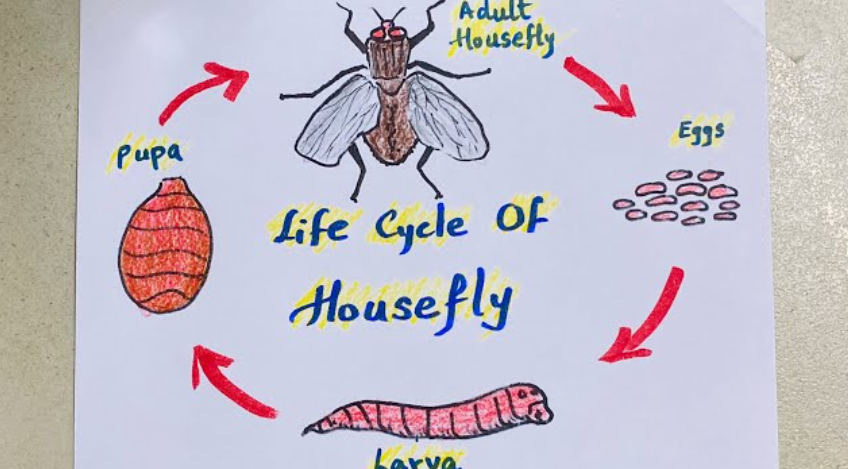
A house fly does not grow slowly, as many larger animals do. Instead, it undergoes complete metamorphosis, which means it has four distinct stages: egg, larva, pupa, and adult. Under warm, suitable conditions, this full cycle can be completed in about 7 to 10 days, which explains why fly numbers can increase very quickly during summer or in dirty environments.
House flies are small, but their impact is large. They help break down organic waste in nature, but they can also carry harmful microorganisms from garbage, feces, and sewage to food surfaces. Because of this, understanding the house fly’s lifespan, eggs, and larvae is important for both ecological knowledge and hygiene control.
Q: How long does a house fly live?
A: A normal adult house fly usually lives around two weeks to one month, depending on temperature, food, moisture, and safety from predators.
Q: What are the four stages of the house fly life cycle?
A: The four stages are egg, larva, pupa, and adult. This is called complete metamorphosis.
Q: Where do house flies lay eggs?
A: Female house flies usually lay house fly eggs on moist, decaying organic matter such as manure, garbage, rotting food, and animal waste.
Quick Life Cycle Table
| Stage | What Happens | Time Needed | Key Point |
| Egg | Females lay eggs on moist waste or manure | 8 to 20 hours | Eggs hatch quickly in warm conditions |
| Larva | House fly larvae or maggots feed and grow | 4 to 7 days | Larvae pass through three growth stages |
| Pupa | Larva changes inside a hard brown case | 2 to 3 days | This is the transformation stage |
| Adult | Adult flies emerge, mate, and lay eggs | 2 weeks to 1 month | Adults reproduce very fast |
The house fly’s life cycle speeds up in warm weather and slows in cool weather. In summer, the cycle may finish in 7 to 10 days, but poor conditions can delay development.

Important Things That You Need To Know
Before studying the full life cycle of the house fly, it is useful to understand a few related terms. A house fly trap is a device that attracts and captures adult house flies. It may use food smell, light, sticky surfaces, or bait. Traps can reduce adult flies, but they work best when breeding places are also cleaned.
The house fly’s lifespan is not just “one day,” as many people believe. Adult house flies commonly live for two weeks to one month in natural conditions, and their survival depends on food, temperature, humidity, and shelter.
House fly eggs are tiny, pale, and usually laid in groups on warm, moist organic material. These eggs hatch quickly, which is why garbage areas can suddenly become full of flies. After hatching, house fly larvae appear as soft, legless maggots. They feed on decaying material and grow rapidly before becoming pupae.
Many people also search for horse fly vs house fly. A horse fly is usually larger, stronger, and often bites animals or humans for blood. A house fly is smaller and does not bite, but it can spread germs by landing on waste and then on food.
So, when people ask how long a house fly lives, the better answer is: the adult may live a few weeks, but the full population grows fast because each female can lay many eggs in repeated batches.
The History of Their Scientific Naming
The scientific name of the common house fly is Musca domestica. This name was first formally used by Carl Linnaeus, the Swedish scientist who created the modern system of naming living organisms. He described the species in 1758 in his famous taxonomic work.
The word Musca comes from Latin and means fly. The word domestica means ‘domestic‘ or ‘connected with the home’. Together, Musca domestica means the fly commonly associated with human houses and settlements.
This name is very suitable because the house fly is one of the most familiar insects around humans. It has been associated with human settlement, livestock farming, food storage, and waste disposal systems for a very long time.
Important points about the name:
- Scientific name: Musca domestica
- Named by: Carl Linnaeus
- Year: 1758
- Order: Diptera, meaning two-winged insects
- Family: Muscidae
- Common name: House fly
The name has remained widely accepted because the species is globally recognized and scientifically important in studies of hygiene, disease transmission, decomposition, and insect development.
Their Evolution And Their Origin
The house fly is believed to have developed a close relationship with humans because human settlements provide ideal breeding grounds. Waste food, animal manure, open drains, livestock farms, and garbage piles gave house flies steady access to food and safe egg-laying sites.
The house fly belongs to the insect order Diptera, which means “two wings.” Most insects have four wings, but flies use one pair for flying and a smaller pair for balance, called halteres. This makes them fast, flexible, and difficult to catch.
Its evolutionary success stems from three main strengths: rapid reproduction, flexible feeding, and strong survival. A female can lay several batches of eggs, and the young larvae can grow in many kinds of decaying organic matter. This allows house flies to multiply quickly when hygiene is poor.
The origin of the modern house fly is often linked with regions where early human and animal settlements created suitable waste-rich habitats. Over time, the species spread widely with human movement, trade, farming, and urban development. GBIF notes that the house fly’s close relationship with humans probably helped its worldwide spread.
Evolution also shaped the house fly’s feeding behavior. Adult flies cannot chew solid food like humans. They feed mostly on liquids or dissolve food by releasing saliva. This ability helps them feed on many surfaces, but it also increases their role in moving microorganisms from dirty areas to clean ones.
Today, Musca domestica is found almost everywhere humans live. Its origin and evolution show how strongly a small insect can adapt to human-made environments.
Their main food and its collection process
The house fly is not a picky feeder. It survives by feeding on liquid or semi-liquid organic material. Since it cannot chew solid food properly, it uses saliva to soften or dissolve food before sucking it up.
Main food sources include:
- Rotting food: Fruits, vegetables, meat scraps, and kitchen waste.
- Animal manure: A common feeding and breeding place, especially near farms.
- Garbage: Open bins and waste piles attract adult flies.
- Sugary liquids: Spilled drinks, fruit juice, and sweet residues.
- Human and animal waste: These can contain harmful microorganisms.
- Dead organic matter: Decaying plant or animal material.
The food collection process is simple but risky for humans. A house fly lands on a food source, tastes it with sensory organs on its feet and mouthparts, and then feeds by sucking liquids. If the food is dry or solid, the fly may release saliva to break it down.
This feeding habit is one reason house flies can spread germs. They may land on garbage, sewage, or feces and later land on cooked food, utensils, or kitchen surfaces. Pathogens can be carried on their feet, mouthparts, and body hairs.
In nature, this process helps break down waste. In human spaces, however, it becomes a hygiene problem. That is why clean food storage, covered bins, and proper waste management are important for controlling house flies.

Their life cycle and ability to survive in nature
Egg Stage
The house fly’s life cycle begins when the female lays eggs on warm, moist, decaying material. These places provide food for the larvae immediately after hatching.
A female can lay many eggs in batches. Under warm conditions, the eggs may hatch within 8 to 20 hours.
Larva Stage
The larval stage is commonly called the maggot stage. House fly larvae are soft, pale, legless, and highly active feeders.
They feed on the waste material where they hatch. During this stage, they pass through three larval instars. This fast-feeding stage helps them grow quickly before pupation.
Pupa Stage
After feeding, the larva moves to a drier place and becomes a pupa. The outer body forms a hard, brown case called the puparium.
Inside this case, the insect changes from a larva into an adult fly. This stage is one of the most important parts of complete metamorphosis.
Adult Stage
The adult house fly emerges from the pupal case and soon becomes ready to reproduce. In warm conditions, the full life cycle may finish within 7 to 10 days.
House flies survive well because they reproduce fast, use many food sources, hide in small spaces, and adapt to both natural and human-made environments.
Their Reproductive Process and raising their children
The reproductive process of the house fly is very fast. Adult flies can become sexually mature soon after emerging from the pupal stage. This quick maturity helps populations grow rapidly.
Key points about reproduction:
- Mating happens after adulthood: Adult males and females mate shortly after emergence when conditions are suitable.
- Females lay eggs in batches: A female may lay several groups of eggs during her life.
- Egg-laying site matters: Females choose moist, nutrient-rich places such as manure, garbage, and rotting food.
- Larvae feed independently: Once the eggs hatch, larvae begin feeding immediately.
- No parental care: House flies do not care for their young as birds or mammals do.
- Survival depends on the environment: Warmth, moisture, and food supply decide how many larvae survive.
The phrase “raising their children” does not fully apply to house flies because they do not protect, feed, or guide their young. Their strategy is different. Instead of caring for a small number of offspring, they produce many eggs and place them where the larvae can feed on them.
This method is very effective. Even if many eggs or larvae die, enough may survive to continue the population. That is why one dirty garbage area or manure pile can produce many flies in a short time.
Good sanitation breaks this reproductive process. If breeding places are removed, eggs and larvae cannot develop properly.
The importance of them in this Ecosystem
Natural Decomposers
The house fly plays an important role in breaking down decaying organic matter. Its larvae feed on waste, manure, and rotting material. This helps recycle nutrients back into the environment.
Although people often see house flies only as pests, their larvae are part of nature’s cleaning system.
Food for Other Animals
House flies are also food for many animals. Birds, spiders, frogs, lizards, beetles, and other insects may eat flies or their larvae.
This makes the house fly part of the food chain. Removing every fly from nature would affect some small predators that depend on insects for food.
Nutrient Recycling
By feeding on waste, house fly larvae help speed up decomposition. This process supports soil nutrients and microbial activity.
In controlled conditions, fly larvae are even studied for organic waste management and animal feed production. However, this must be done carefully because house flies can also carry pathogens.
Public Health Warning
Their ecological role does not mean they should be allowed inside kitchens, hospitals, restaurants, or food storage areas. House flies can transfer harmful microorganisms from dirty places to food and surfaces.
So, their importance is balanced. In nature, they help decomposition. In human living spaces, proper control is needed.
What to do to protect them in nature and save the system for the future
Protecting the Ecosystem does not mean allowing house flies to spread in homes or food areas. The goal is balance: protect natural decomposition systems while keeping human spaces clean and safe.
- Keep natural habitats balanced: Do not unnecessarily destroy insect habitats. Flies are part of the food web.
- Manage waste properly: Use covered bins, compost systems, and regular cleaning to prevent uncontrolled breeding.
- Avoid overusing insecticides: Excessive chemical spraying can harm beneficial insects, predators, and soil organisms.
- Support natural predators: Birds, spiders, frogs, and lizards help naturally control fly numbers.
- Use compost carefully: Compost can support decomposition, but it should be managed properly to prevent it from becoming a breeding ground for flies.
- Keep food areas separate: Let decomposition happen in controlled outdoor systems, not near kitchens or dining spaces.
- Use traps wisely: A housefly trap can reduce adult houseflies without harming the wider Ecosystem.
- Improve public hygiene: Clean drains, cover food, wash bins, and remove manure or waste buildup.
- Protect biodiversity: A healthy ecosystem naturally controls fly populations through predators and competition.
- Teach safe coexistence: People should understand that house flies have ecological value, but they must be controlled around food and health-sensitive areas.

Frequently Asked Questions (FAQs)
Q1: What is the house fly’s life cycle?
A: The house fly life cycle has four stages: egg, larva, pupa, and adult. This process is called complete metamorphosis.
Q2: How long does a house fly live?
A: An adult house fly usually lives around two weeks to one month, depending on temperature, food, moisture, and environmental safety.
Q3: How fast do house fly eggs hatch?
A: House fly eggs can hatch within 8 to 20 hours in warm and suitable conditions.
Q4: What do house fly larvae eat?
A: House fly larvae eat moist, decaying organic matter such as manure, rotting food, garbage, and animal waste.
Q5: Are house flies dangerous?
A: House flies can be risky because they may carry microorganisms from garbage, sewage, and feces to food or surfaces.
Q6: What is the difference between a horse fly and a house fly?
A: A horse fly is usually larger and may bite animals or humans. A house fly is smaller and does not bite, but it can spread germs by landing on dirty and clean surfaces.
Q7: Does a house fly trap really work?
A: A house fly trap can help catch adult flies, but it works best with sanitation. If breeding places remain, new flies will continue to appear.
Q8: Why do house flies come into homes?
A: House flies enter homes for food, moisture, warmth, and breeding opportunities. Open garbage, uncovered food, dirty drains, and animal waste attract them.
Conclusion
The house fly’s life cycle is fast, efficient, and highly adapted to human environments. From tiny house fly eggs to active house fly larvae, then pupae and adults, each stage helps the species survive and multiply quickly. Under warm conditions, the full cycle can finish in only a few days, which is why fly problems can grow suddenly.
The house fly is both useful and harmful. In nature, it helps break down waste and supports the food chain. Around people, it can become a serious hygiene concern because it can transfer from dirty materials to clean food surfaces.
The best approach is balance. We should respect its ecological role while controlling it in homes, farms, restaurants, and public spaces. Clean surroundings, covered waste, safe composting, screens, and smart use of a house fly trap can reduce problems without damaging the wider Ecosystem.
Also Read: bagworm life cycle
About the Author