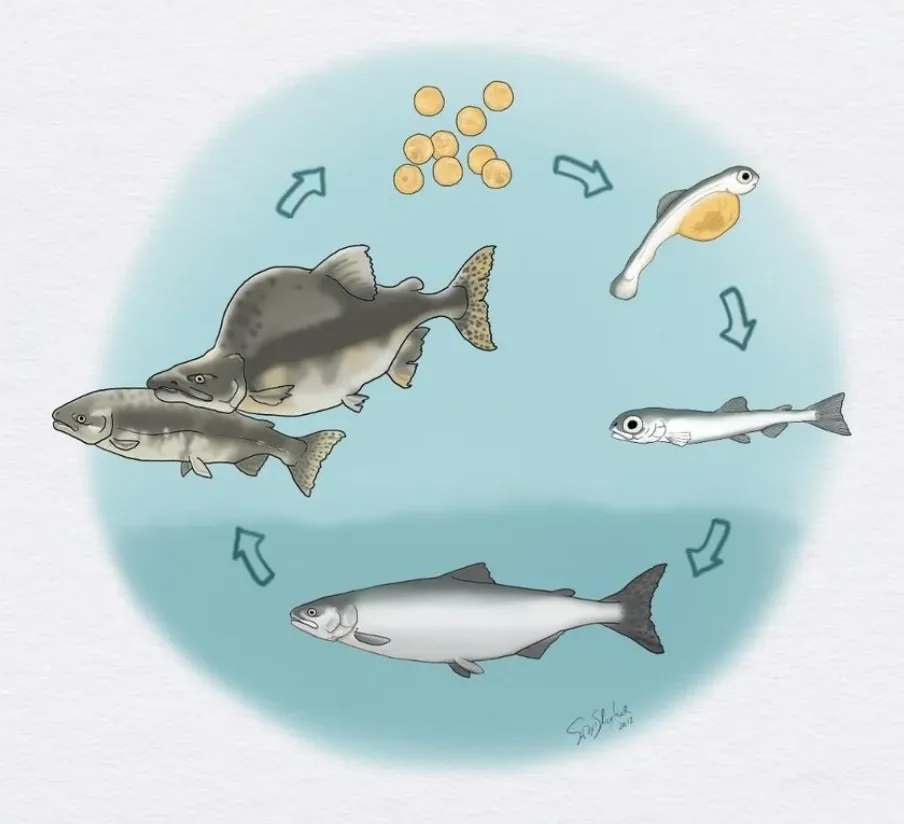
The life cycle of a salmon is one of the most remarkable journeys in the animal kingdom. A salmon fish begins life as a tiny egg hidden under clean river gravel, grows through several freshwater stages, migrates to the ocean, travels long distances to feed and mature, and then returns to its birthplace to reproduce. This powerful movement between river and sea is called anadromous migration, and it makes salmon a key species in freshwater, marine, and forest ecosystems.
Most people know salmon as a healthy food, a popular seafood, or a recipe ingredient for oven-baked salmon, air-fried salmon, or salmon patties. But before reaching markets and kitchens, wild salmon pass through a complex natural process shaped by water temperature, oxygen level, predators, migration barriers, ocean food supply, and spawning habitat.
Understanding the salmon life cycle helps us see why rivers, forests, oceans, and fish populations are deeply connected. When adult salmon return from the sea and die after spawning, their bodies bring ocean nutrients back into rivers and surrounding land, supporting wildlife, plants, and future generations of young salmon.
Quick Answers: Most Common Questions
Q: What are the main stages in the life cycle of a salmon?
A: The main stages are egg, alevin, fry, parr, smolt, ocean adult, returning adult, and spawning adult.
Q: Do all salmon die after spawning?
A: Most Pacific salmon, including sockeye salmon, die after spawning. Atlantic salmon may survive spawning and return to the sea as kelts, and some can spawn again.
Q: Why do salmon return to the river where they were born?
A: Salmon use strong homing behavior, guided by environmental cues such as smell and river conditions, to return to their natal waters for reproduction.
Quick Life Cycle Table
| Stage | Where It Happens | What Happens |
| Egg | Freshwater gravel nest | The female lays eggs in a nest; the male fertilizes them. |
| Alevin | Under gravel | Baby salmon live on their attached yolk sac. |
| Fry | Stream or lake edge | Young salmon begin feeding on tiny insects and invertebrates. |
| Parr | Freshwater stream | Develops vertical markings for camouflage. |
| Smolt | River mouth or estuary | The body changes to survive saltwater. |
| Ocean Adult | Sea or ocean | Salmon grow quickly by feeding on plankton, fish, squid, and crustaceans. |
| Returning Adult | Ocean to river | Adult migrates back to birthplace. |
| Spawner | Freshwater gravel bed | Adults lay and fertilize eggs; many Pacific salmon die after spawning. |
Salmon life-cycle timing varies by species and location. For example, Atlantic salmon juveniles may spend 1 to 3 years in freshwater before moving into the ocean, whereas some Pacific salmon species leave freshwater much sooner.

Important Things That You Need To Know
The word salmon is commonly used for several related fish species, not just one single species. Atlantic salmon belong mainly to the genus Salmo, while Pacific salmon belong to the genus Oncorhynchus. Popular Pacific salmon species include sockeye, Chinook, coho, chum, and pink.
In search behavior, people often use related terms such as salmon fish, salmon in oven, air fry salmon, salmon patties, and sockeye salmon. These keywords show different user intentions. Some readers want biology, some want cooking advice, and some want species-specific facts. For this article, the focus is on the life cycle of a salmon, but it is useful to understand how these related terms connect.
For example, sockeye salmon is not just a recipe name. It is a real Pacific salmon species known for its strong red spawning color and life cycle that often includes freshwater lake rearing before ocean migration. NOAA notes that sockeye fry may spend one to three years in freshwater before reaching the smolt stage and moving to the ocean.
Cooking-related searches such as salmon in oven, air fry salmon, and salmon patties usually refer to food preparation, not biology. However, responsible seafood choices are linked to the natural life cycle because healthy wild populations depend on clean rivers, connected migration routes, and sustainable fisheries.
The History of Their Scientific Naming
The scientific naming of salmon is rooted in taxonomy, the system scientists use to classify living organisms. The Atlantic salmon is scientifically known as Salmo salar, a name formally associated with Linnaeus in 1758. It belongs to the family Salmonidae, which also includes trout, char, grayling, and whitefish.
The Pacific salmon group is placed mainly in the genus Oncorhynchus. This genus includes well-known species such as Oncorhynchus nerka (sockeye salmon), Oncorhynchus kisutch (coho salmon), and Oncorhynchus tshawytscha (Chinook salmon). Britannica identifies six major Pacific salmon species in the genus Oncorhynchus.
The naming reflects physical traits, geography, and historical discovery. The genus Oncorhynchus is often linked with the hooked jaw or snout shape that mature male Pacific salmon may develop during spawning. These scientific names help researchers separate similar-looking fish and study their migration, reproduction, genetics, and conservation status more accurately.
In simple terms, “salmon” is the common name, but scientific names like Salmo salar and Oncorhynchus nerka allow researchers worldwide to discuss specific species without confusion.
Their Evolution And Their Origin
The origin of salmon is closely tied to the cold, oxygen-rich waters of the Northern Hemisphere. Salmon are part of the family Salmonidae, a group of cold-water fishes that evolved with strong swimming ability, sensitivity to water temperature, and flexible life histories. Their ancestors adapted to environments where rivers, lakes, estuaries, and oceans were connected.
One of the most important evolutionary traits of salmon is anadromy. This means they hatch in freshwater, move to saltwater to grow, and return to freshwater to spawn. This strategy gives salmon access to rich ocean feeding grounds while still using freshwater gravel beds as protected nurseries for eggs.
Over time, different salmon species developed different survival strategies. Some, like pink salmon, have a short and predictable life cycle. Others, like Chinook and Atlantic salmon, can spend more time growing before reproduction. Sockeye salmon often depend heavily on lake systems during the juvenile stage, while some landlocked forms remain in freshwater for life.
The ability to shift from freshwater to saltwater required major physiological adaptation. During the smolt stage, salmon change their body chemistry so their gills and internal systems can handle salty ocean water. This transformation is one reason salmon can survive in two very different worlds.
Salmon evolution also shaped the ecosystems around them. Bears, eagles, otters, insects, trees, and even microorganisms benefit from salmon runs. When adult salmon return from the ocean, they bring stored marine energy into rivers and forests. This makes salmon more than a fish; they are natural nutrient carriers between ocean and land.
Their main food and its collection process
The diet of salmon changes greatly as they grow. A baby salmon does not hunt immediately after hatching. In the alevin stage, it stays under the gravel and survives on its attached yolk sac. This gives it energy while it remains hidden from predators.
Once it becomes a fry, it leaves the gravel and begins searching for food in shallow freshwater areas. Young salmon commonly eat small aquatic insects, insect larvae, tiny invertebrates, and other small organisms found in streams and lakes. NOAA explains that young Atlantic salmon eat insects and invertebrates in freshwater, then shift toward plankton and larger prey at sea.
As salmon grow into parr, they become stronger hunters. Their vertical body markings help them hide among stones, shadows, and stream vegetation. They collect food by holding position in flowing water and snapping up drifting insects or small prey carried by the current.
During the smolt and early ocean stage, salmon feed more actively. In marine waters, many salmon eat zooplankton, krill, squid, small fish, crustaceans, and other invertebrates. Larger adult salmon may prey on herring, sand lance, capelin, smelt, and mackerel.
Key food collection methods include:
- Drift feeding: Young salmon wait in the current and catch floating insects or larvae.
- Surface feeding: Fry and parr feed on insects at the water surface.
- Active hunting: Older salmon chase small fish, squid, and crustaceans.
- Ocean feeding migration: Adults travel widely to find richer feeding areas.
- Energy storage: Before spawning migration, salmon build fat and muscle reserves for the long journey home.
When adult salmon enter freshwater to spawn, many species stop feeding. They rely on stored energy to swim upstream, compete for mates, build nests, and reproduce.

Their life cycle and ability to survive in nature
Egg Stage: Hidden Under Gravel
The life cycle begins when a female salmon digs a shallow nest called a redd in clean gravel. She deposits eggs, and a male fertilizes them. The eggs need cold, oxygen-rich water flowing through the gravel. Too much silt can block oxygen and reduce survival.
Alevin Stage: Living on the Yolk Sac
After hatching, the young salmon is called an alevin. It remains under the gravel and feeds from its yolk sac. This stage is delicate because the fish cannot swim strongly or escape easily.
Fry and Parr Stage: Learning to Feed
When the yolk sac is absorbed, the young salmon emerges as a fry. It begins feeding and avoiding predators. Later, it becomes a parr, marked with dark vertical bars that help it blend into freshwater habitats.
Smolt Stage: Preparing for Saltwater
The smolt stage is one of the most important stages for survival. The salmon’s body changes so it can live in saltwater. Smolts often move through estuaries, where freshwater and seawater mix.
Adult Stage: Growing in the Ocean
In the ocean, salmon feed heavily and grow rapidly. NOAA notes that Pacific salmon may spend up to several years at sea and can travel long distances along the coast and across international waters.
Spawning Return: The Final Journey
Mature salmon return to their natal river to spawn. This journey is dangerous because they face predators, dams, warm water, low flows, disease, and exhaustion. Their survival depends on clean habitat, open migration routes, and healthy ocean conditions.
Their Reproductive Process and raising their children
Salmon reproduction begins when mature adults return from the ocean to freshwater. This return migration is often physically demanding. Some salmon travel hundreds of miles upstream, using stored energy because many stop eating once they enter freshwater.
The reproductive process usually follows these steps:
- Homing to birthplace: Adult salmon return to the river, stream, or lake system where they were born.
- Selection of spawning site: The female chooses clean gravel with good water flow.
- Redd building: She turns on her side and beats her tail to dig a nest in the gravel.
- Egg laying: The female releases eggs into the redd.
- Fertilization: The male releases milt over the eggs.
- Covering the eggs: The female covers the fertilized eggs with gravel to protect them.
- Post-spawning stage: Many Pacific salmon die within days or weeks after spawning. Atlantic salmon may survive and return to the ocean as kelts.
Salmon do not raise their children like mammals or birds. There is no feeding, guarding, or teaching after eggs are buried. Instead, their “parental care” happens before hatching through careful nest selection and gravel covering.
The eggs develop over winter or over several weeks, depending on the species, water temperature, oxygen levels, and local conditions. U.S. Fish and Wildlife Service material notes that Pacific salmon eggs may hatch after several weeks to months, with timing varying by species and water conditions.
After hatching, the young salmon must survive mostly on instinct. Their early life depends on clean water, stable gravel, shade, natural stream flow, and enough tiny food organisms.
The importance of them in this Ecosystem
Salmon Connect Ocean, River, and Forest
Salmon are often called keystone species because their life cycles connect multiple ecosystems. They grow in the ocean, return to rivers, spawn, and leave behind nutrients that support freshwater and land-based life.
Food for Wildlife
Adult salmon are important food for bears, eagles, otters, wolves, seals, sea lions, larger fish, and many scavengers. Young salmon also feed birds, fish, and aquatic predators. This makes salmon part of both predator and prey networks.
Nutrient Transport
When salmon die after spawning, their bodies release marine-derived nutrients into streams and nearby forests. These nutrients can support algae, insects, juvenile fish, riparian plants, and trees. USGS research also shows that nutrients from salmon carcasses can improve freshwater food webs and support juvenile salmon growth and survival.
Support for Human Communities
Salmon are also culturally, economically, and nutritionally important. Indigenous communities, commercial fishers, recreational anglers, restaurants, and seafood markets all depend on healthy salmon populations.
Indicator of Environmental Health
A strong salmon run often signals that a river system is functioning well. When salmon decline, it may indicate problems such as pollution, dams, habitat loss, warming water, overfishing, or poor ocean conditions.
What to do to protect them in nature and save the system for the future
Protecting salmon means protecting the full journey from egg to ocean adult and back again. Since salmon use rivers, estuaries, oceans, and forests, conservation must focus on the whole connected system.
- Protect clean spawning rivers: Salmon eggs need gravel with cold, oxygen-rich water. Reducing pollution, sediment, and chemical runoff helps eggs survive.
- Restore damaged river habitat: Replanting riverbank vegetation, reconnecting side channels, and restoring natural stream flow can improve juvenile salmon shelter and food supply.
- Remove or improve migration barriers: Dams, culverts, and blocked streams can stop salmon from reaching spawning grounds. Fish passages and barrier removal can reopen habitat.
- Keep water temperatures cool: Shade from trees, healthy groundwater flow, and climate action help reduce heat stress during migration and spawning.
- Manage fishing responsibly: Sustainable harvest rules help ensure enough adult salmon return to reproduce.
- Protect estuaries: Smolts need estuaries to adjust from freshwater to saltwater. Wetland protection gives young salmon safer transition zones.
- Reduce plastic and chemical pollution: Cleaner rivers and oceans improve salmon survival and protect the food web.
- Support science-based monitoring: Life-cycle monitoring helps managers understand which stage is causing population decline.
- Choose sustainable seafood: Consumers can support fisheries and farms that follow responsible environmental standards.
- Respect spawning areas: Avoid walking on gravel beds where salmon eggs may be buried.
Salmon conservation is not only about saving one fish. It is about protecting rivers, forests, oceans, wildlife, and future food systems.

Frequently Asked Questions (FAQs)
Q: What is the life cycle of a salmon?
A: The life cycle of a salmon includes egg, alevin, fry, parr, smolt, ocean adult, returning adult, and spawning adult stages.
Q: Where do salmon lay their eggs?
A: Salmon lay eggs in freshwater gravel nests called redds. These nests are usually built in cold, clean streams or rivers.
Q: What is an alevin in the salmon life cycle?
A: An alevin is a newly hatched salmon that stays under gravel and feeds from its attached yolk sac.
Q: What is a smolt?
A: A smolt is a young salmon that has developed the body changes needed to move from freshwater into saltwater.
Q: How long do salmon live?
A: Lifespan depends on species. Some Pacific salmon live only a few years, while Atlantic salmon can live longer and may spawn more than once. Sockeye salmon commonly mature at ages 4 or 5, depending on the region.
Q: Do salmon always return to the same river?
A: Many salmon return to their natal river or stream to reproduce. This behavior is called homing.
Q: Why do many salmon die after spawning?
A: Many Pacific salmon use nearly all their stored energy for migration, nest building, mating, and spawning. After reproduction, their bodies weaken, and they die, adding nutrients back to the Ecosystem.
Q: Is sockeye salmon different from other salmon?
A: Yes. Sockeye salmon is a Pacific salmon species known for its red spawning color. Many sockeye spend part of their juvenile life in freshwater lakes before migrating to the ocean.
Conclusion
The life cycle of a salmon is a powerful example of survival, migration, reproduction, and ecological connection. From a small egg buried under river gravel to a strong adult returning from the ocean, every stage depends on clean water, safe habitat, natural food, and open migration routes.
Salmon are not only valuable as a food source for humans; they are also essential to rivers, forests, oceans, and wildlife. Their bodies move nutrients from the sea back to freshwater ecosystems, feeding insects, birds, mammals, plants, and future young salmon.
Protecting salmon means protecting the entire natural system around them. Healthy salmon runs require responsible fishing, restored rivers, protected estuaries, cooler water, and long-term conservation. When salmon survive, many other forms of life survive with them.
Also Read: ladybeetle life cycle
About the Author