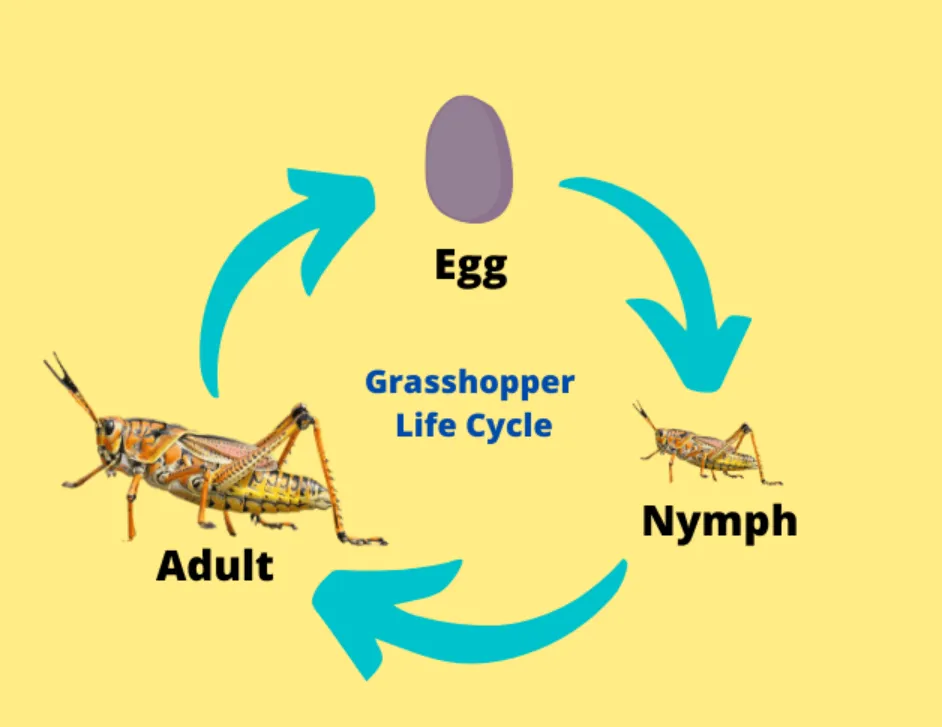
The life cycle of a grasshopper is one of the clearest examples of incomplete metamorphosis in insects. Unlike butterflies, grasshoppers do not pass through a pupal stage. Their development moves through three main stages: egg, nymph, and adult. This simple but highly effective life cycle helps grasshoppers survive in grasslands, crop fields, gardens, forests, and dry open areas.
A grasshopper is not one single species. It is a common name for many jumping insects that belong mainly to the order Orthoptera and the suborder Caelifera. Many familiar short-horned grasshoppers belong to the family Acrididae, which includes thousands of species worldwide. Grasshoppers are known for their strong hind legs, chewing mouthparts, short antennae, and ability to jump quickly when threatened. Britannica describes grasshopper nymphs as young forms that look like adults but are smaller and lack fully developed wings and reproductive organs.
Q: What are the main stages in the life cycle of a grasshopper?
A: The main stages are egg, nymph, and adult.
Q: Does a grasshopper have a pupa stage?
A: No. Grasshoppers have incomplete metamorphosis, so they do not form a pupa or cocoon.
Q: How long does a grasshopper live?
A: Many grasshoppers complete their life cycle in about one year, though adult life often lasts only a few months, depending on species, food, weather, and predators. UC IPM notes that adults can live for about 2 to 3 months in many cases.
Quick Life Cycle Table
| Stage | What Happens | Key Feature | Survival Need |
| Egg | Females lay eggs in soil, often in pods | Protected underground | Safe soil, moisture balance, winter protection |
| Nymph | Young grasshopper hatches and starts feeding | Looks like a small adult but wingless | Tender plants, warm weather, hiding places |
| Molting | A nymph sheds skin several times | The body grows after each molt | Food, low predator pressure |
| Adult | Fully developed wings and reproductive organs appear | Can mate and lay eggs | Food, mate, suitable egg-laying soil |

Important Things That You Need To Know
When writing or learning about the life cycle of a grasshopper, it is important to separate real biological terms from search-related words that may have different meanings. The word “grasshopper” can refer to an insect, but online searches may also return results for unrelated topics.
For example, a grasshopper drink is usually a mint-flavored cocktail, not an insect topic. Grasshopper pie is a dessert name, not part of insect biology. The term “Grasshopper dispensary” usually refers to a business name or local brand, not to an animal’s life cycle. Grasshopper mouse is a different animal; it is a small carnivorous rodent, not a grasshopper. These terms can appear as LSI keywords, but they should not be mixed into the scientific explanation as if they describe the insect.
Some LSI keywords are directly useful. A lubber grasshopper is a real grasshopper known for its large body and slow movement. Locust vs grasshopper is also important because locusts are certain grasshopper species that can become highly social and form destructive swarms under specific conditions. Britannica notes that locusts are swarming, migratory grasshoppers, especially within short-horned grasshopper groups.
For SEO, the best approach is to mention these terms naturally, explain which ones are related, and avoid keyword stuffing. This keeps the article helpful for readers and safer for search engines.
The History of Their Scientific Naming
The scientific naming of grasshoppers is connected to insect classification. Grasshoppers belong to the order Orthoptera, a name derived from Greek roots meaning straight wing. The order includes grasshoppers, crickets, and katydids. The name reflects the structure of their wings, especially the straight-veined hind wings folded under tougher forewings. GBIF also describes the etymology of Orthoptera from Greek words for “straight” and “wing.”
Key naming points:
- Kingdom: Animalia
- Phylum: Arthropoda
- Class: Insecta
- Order: Orthoptera
- Suborder: Caelifera
- Common family: Acrididae
The word Caelifera is commonly linked with short-horned grasshoppers and grasshopper-like insects. It is often interpreted as “chisel-bearing,” referring to the shape of the female ovipositor used for egg laying in soil.
The family Acrididae includes many of the best-known short-horned grasshoppers. Britannica states that short-horned grasshoppers are the largest and most familiar grasshopper group, with around 10,000 species.
This naming history matters because “grasshopper” is a common name, not a single scientific species name.
Their Evolution And Their Origin
The origin of grasshoppers dates back to the early stages of insect history. Grasshoppers are part of Orthoptera, an ancient insect order that includes jumping insects with chewing mouthparts and strong hind legs. Research summarized by Entomology Today reports that Orthoptera likely originated in the Carboniferous period, roughly 350–300 million years ago, while the two major suborders, Ensifera and Caelifera, diverged around the Permian period, roughly 300–250 million years ago.
This long evolutionary history helped grasshoppers adapt to many environments. Their bodies are simple but powerful. Strong hind legs allow fast jumping. Chewing mouthparts allow them to eat grasses, leaves, crops, and other plant material. Their body color often blends with dry grass, soil, or green vegetation, helping them escape predators.
Grasshoppers are hemimetabolous insects, meaning their young resemble smaller adults. This system differs from that of butterflies or beetles, which undergo complete metamorphosis. Since grasshopper nymphs can begin feeding soon after hatching, they can grow quickly when warm weather and food are available.
Over time, grasshoppers spread into grasslands, forests, deserts, wetlands, mountains, and agricultural areas. Their success comes from their flexible diet, strong mobility, protective egg-laying behavior, and ability to reproduce in large numbers.
Their main food and its collection process
Grasshoppers are mostly herbivorous insects, meaning they mainly eat plants. Many species prefer grasses, cereal crops, leaves, weeds, and tender shoots. However, not all grasshoppers eat the same food. The British Ecological Society notes that grasshoppers can play different feeding roles, and some species are not strictly grass-eaters.
Their food collection process is simple but effective:
- Searching for food: Nymphs often feed close to where they hatch because they cannot fly. Adults can travel farther using jumps and flight.
- Choosing tender plants: Young grasshoppers prefer soft leaves, young grass, and tender plant tissue.
- Biting and chewing: Grasshoppers use strong mandibles to cut and grind plant material.
- Moving when food is low: UC IPM notes that nymphs can move to new places when food supplies disappear.
- Feeding during warm hours: Grasshoppers are usually more active in warm, dry weather.
- Using camouflage: Many grasshoppers feed while staying hidden among grasses or low plants.
Their feeding habit can benefit nature by converting plant material into insect biomass. But in large numbers, grasshoppers can damage crops, gardens, and pastureland. This is why they are both ecologically important and sometimes considered agricultural pests.
Their life cycle and ability to survive in nature
Egg Stage
The egg stage is the beginning of the grasshopper life cycle. Female grasshoppers usually lay eggs in soil, often in protected pods. UC IPM states that eggs are commonly laid in the upper soil layer in elongated pods, and each pod may contain 20 to more than 100 eggs, depending on the species and conditions.
Eggs often survive through winter in the soil. Soil cover, vegetation, and weather conditions can affect survival.
Nymph Stage
After the eggs hatch, young grasshoppers emerge as nymphs. They look like tiny adults but do not have fully developed wings. University of Minnesota Extension explains that nymphs usually undergo about 5 molts before becoming adults.
Each molt allows the nymph to grow larger. During this stage, they are vulnerable to birds, spiders, insects, weather changes, and food shortages.
Adult Stage
Adult grasshoppers have developed wings and reproductive organs. They can mate, move farther, and search for better food sources. UC IPM notes that most species molt five to six times before adulthood and usually have one generation per year.

Their Reproductive Process and raising their children
Grasshopper reproduction begins when adult males and females become sexually mature. Males often attract females through movement, sound, vibration, or species-specific behavior. After mating, the female searches for suitable soil where the eggs can survive.
Important reproductive points:
- Mating: Male grasshoppers transfer sperm to the female during mating.
- Egg laying: The female uses her ovipositor to lay eggs in the soil.
- Egg pods: Eggs are often covered in a protective material that helps hold them together.
- Soil selection: Females usually prefer undisturbed soil, grassy areas, field edges, ditch banks, roadsides, or pasture-like habitats.
- No parental care: Grasshoppers do not care for their young as birds or mammals do.
- Independent nymphs: Once nymphs hatch, they feed and survive on their own.
- High egg numbers: Laying many eggs increases the chance that some offspring will survive predators, disease, and bad weather.
Britannica explains that females deposit eggs in holes and that the eggs may be surrounded by a protective mass that dries into an egg pod.
So, grasshoppers do not “raise children” in the emotional or social sense. Their survival strategy is based on protected egg placement, large egg numbers, and fast independent development.
The importance of them in this Ecosystem
A Key Food Source
Grasshoppers are an important food source for many animals. Birds, reptiles, amphibians, spiders, predatory insects, and small mammals may eat grasshoppers at different life stages. This makes them a strong link between plants and higher-level predators.
Plant Population Control
Because grasshoppers feed on grasses and leaves, they help influence plant growth and plant competition. In balanced numbers, their feeding can help shape grassland structure.
Nutrient Cycling
Grasshoppers return nutrients to the soil through droppings, shed skins, and dead bodies. These materials break down and support soil organisms, which in turn help nutrient cycling.
Biodiversity Support
Grasshoppers support biodiversity by serving as prey, herbivores, and competitors. Their presence can indicate habitat quality, especially in grasslands and open natural areas.
Scientific Value
Grasshoppers are useful for studying insect development, evolution, behavior, pest management, and environmental change. Because their life cycles are clear and visible, they are often used in biology education.
Although they can become pests in farms and gardens, grasshoppers are not “bad insects.” They are part of a natural food web and help maintain ecological balance.
What to do to protect them in nature and save the system for the future
Protecting grasshoppers does not mean allowing crop destruction. It means maintaining a balance with nature while carefully managing pest outbreaks.
- Protect natural grasslands: Grasshoppers need open habitats, native grasses, and undisturbed soil for feeding and egg laying.
- Avoid unnecessary pesticide use: Broad-spectrum insecticides can kill grasshoppers, pollinators, predators, and other beneficial insects.
- Use targeted pest control: When grasshoppers damage crops, use integrated pest management instead of random spraying.
- Keep native plants: Native grasses and wild plants support grasshoppers and the animals that eat them.
- Maintain field edges: Ditches, hedgerows, and grassy margins provide habitat for insects and predators.
- Encourage natural predators: Birds, spiders, frogs, reptiles, and predatory insects help control grasshopper populations naturally.
- Reduce habitat destruction: Urban expansion, overgrazing, and heavy land clearing can reduce insect diversity.
- Monitor outbreaks early: Young nymphs are easier to manage than adults because they cannot fly far.
- Teach ecological value: People often see grasshoppers only as pests, but they also support food chains and nutrient cycling.
- Balance farming and conservation: Healthy ecosystems need both crop protection and insect biodiversity.

Frequently Asked Questions (FAQs)
Q1: What is the life cycle of a grasshopper?
A: The life cycle of a grasshopper has three main stages: egg, nymph, and adult. This is called incomplete metamorphosis.
Q2: How many stages are in a grasshopper’s life cycle?
A: There are three main stages. However, the nymph stage includes several molts before the grasshopper becomes an adult.
Q3: Do grasshoppers turn into butterflies?
A: No. Grasshoppers do not turn into butterflies. They are different insects with different life cycles.
Q4: Do grasshoppers have a larva stage?
A: No. Grasshoppers have nymphs, not larvae. Nymphs look like small adults but lack fully developed wings.
Q5: How long does it take for a grasshopper egg to hatch?
A: In many temperate areas, eggs are laid in late summer or fall and hatch in spring when soil temperatures become warm. Timing depends on species, weather, and location.
Q6: What do baby grasshoppers eat?
A: Baby grasshoppers, called nymphs, usually eat tender grasses, leaves, and soft plant tissue near the hatching area.
Q7: What is the difference between a locust and a grasshopper?
A: A locust is a type of grasshopper that can change behavior and form swarms under certain conditions. Not all grasshoppers are locusts.
Q8: Are grasshoppers harmful or helpful?
A: Grasshoppers are both helpful and harmful depending on population size. In balanced numbers, they support food chains and nutrient cycling. In large numbers, they can damage crops and gardens.
Conclusion
The life cycle of a grasshopper is simple, efficient, and perfectly adapted to survival in nature. From hidden eggs in the soil to active nymphs and fully developed adults, each stage has a clear purpose. Grasshoppers undergo incomplete metamorphosis, meaning they do not have a pupal stage. This allows young nymphs to begin feeding soon after hatching and develop quickly when conditions are favorable.
Grasshoppers are important members of the Ecosystem. They feed on plants, become food for many animals, help recycle nutrients, and support biodiversity. At the same time, they can become agricultural pests when populations grow too large. The best approach is balance: protect natural habitats, support predators, avoid unnecessary pesticide use, and manage outbreaks carefully.
Also Read: life cycle of a beehive
About the Author