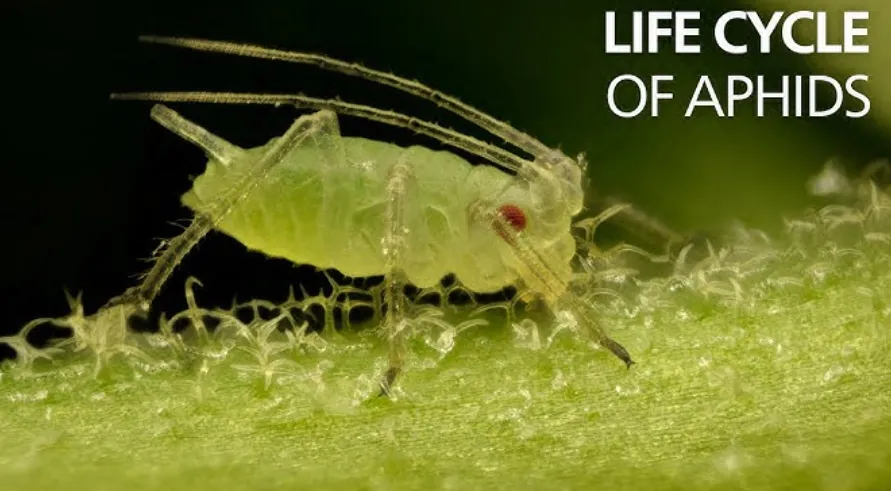
The aphid’s life cycle is among the fastest and most flexible in the insect world. Aphids are tiny, soft-bodied insects that feed on plant sap using needle-like mouthparts. They are often seen on tender shoots, flower buds, young leaves, stems, and the undersides of leaves.
What makes aphids so interesting is how quickly they multiply. In warm weather, many aphids do not need males to reproduce. Female aphids can give birth to live young, and those young may mature within a few days. In some species, a single female can produce hundreds of offspring across several generations, which is why aphids on plants can turn from a small cluster into a heavy infestation very quickly. University of Minnesota Extension notes that aphids may reach sexual maturity in about four to ten days and live around one month on average.
Aphids are not only garden pests. They also play a role in the food chain. Lady beetles, lacewings, hoverfly larvae, parasitic wasps, and many birds depend on them as food. So, while gardeners often search for how to get rid of aphids, the best approach is usually balance, not destruction.
Q: What are aphids?
A: Aphids are small sap-feeding insects from the group Aphidoidea, with many common pest species belonging to the family Aphididae.
Q: What do aphids look like?
A: Aphids are usually tiny, pear-shaped insects. They may be green, black, yellow, brown, pink, gray, or white, and often have two small tube-like structures called cornicles near the rear of the body.
Q: How fast is the aphid’s life cycle?
A: In warm weather, many aphids can mature in less than two weeks, and some become reproductive in only four to ten days.
Quick Life Cycle Table
| Stage | What Happens | Time / Season | Key Detail |
| Egg | Eggs survive cold seasons on host plants | Winter or cool season | Many aphids overwinter as eggs |
| Stem Mother | The first female hatches and starts the spring colony | Early spring | Often called fundatrix |
| Nymph | Young aphids feed on sap and grow through molts | A few days to 2 weeks | Looks like a smaller adult |
| Wingless Adult | Produces live young without mating | Spring and summer | The population increases fast |
| Winged Adult | Moves to new plants when crowded or food declines | Warm season | Helps spread infestations |
| Sexual Generation | Males and females appear in many species | Late summer or fall | Mating produces winter eggs |
| Overwintering Egg | Eggs wait through harsh weather | Winter | The cycle begins again in the spring |

The History of Their Scientific Naming
The scientific naming of aphids has changed as insect classification has improved. Earlier naturalists grouped many sap-sucking insects because they looked and behaved similarly. Later, scientists separated them more carefully by body structure, feeding organs, wings, and evolutionary relationships.
Important points:
- The common name “aphid” is derived from the Latinized name Aphis, used in early scientific naming.
- Many living aphids belong to the family Aphididae.
- Aphids are placed in the order Hemiptera, the same broad insect order that includes many true bugs.
- They belong to the suborder Sternorrhyncha, a group of plant-sucking insects that also includes whiteflies, scale insects, and psyllids.
- Modern classification often uses Aphidoidea as the name of the larger superfamily for aphids and their close relatives.
- Some older classifications used the term Homoptera, but modern insect taxonomy no longer treats it as a single group.
Today, scientists identify aphids not only by appearance but also by host plant, life cycle, genetics, and microscopic body details.
Their Evolution And Their Origin
Aphids have a long evolutionary history. They are ancient plant-feeding insects that adapted to sucking sap from vascular plants. Their soft bodies do not fossilize easily, so the fossil record is less complete than that of insects with harder shells. Still, fossils preserved in amber and rock deposits show that aphid-like insects existed millions of years ago.
Aphids are believed to have evolved alongside changing plant life. As seed plants and later flowering plants spread across the earth, aphids became more specialized. Many aphid species today are closely associated with specific plant groups. Some feed on only one plant species, while others can survive on many. Wisconsin Horticulture notes that many aphids are host-specific, and only about 10% of aphid species alternate between a woody primary host and a herbaceous summer host.
This close link between aphids and plants helped shape their evolution. Their piercing-sucking mouthparts became highly suited for reaching phloem sap, the sugary fluid that moves through plant tissues. But phloem sap is low in some essential nutrients, so aphids also rely on internal bacterial partners that help provide needed amino acids.
Their reproductive system is another major evolutionary strength. Many aphids can switch between asexual and sexual reproduction. In good conditions, females give birth quickly without mating. When seasons change, some species produce males and females, which mate and lay eggs that survive winter.
This mix of fast reproduction, host switching, winged forms, and cold-resistant eggs has made aphids successful across gardens, farms, forests, orchards, and wild ecosystems.
Their main food and its collection process
Aphids’ main food is plant sap, especially phloem sap. This sap is rich in sugars but not always rich in proteins or amino acids. To survive on this thin-liquid diet, aphids have evolved a careful feeding strategy.
They do not chew leaves like caterpillars. Instead, they pierce plant tissue with sharp mouthparts called stylets. These stylets slide between plant cells until they reach the sap-carrying tubes inside the plant.
Their food collection process works like this:
- Finding a host plant: Winged aphids may use sight and smell to locate suitable plants.
- Testing the surface: After landing, the aphid touches and probes the plant.
- Inserting the stylet: The stylet enters the leaf, stem, or bud tissue.
- Reaching the phloem: The aphid searches for sap-rich tissue.
- Sucking sap: Once connected, it feeds for long periods.
- Removing excess sugar: Aphids take in more sugar than they need, which they then excrete as a sticky waste called honeydew.
Honeydew often attracts ants. Some ants protect aphids from predators because the ants feed on the aphids’ sweet honeydew. This relationship can help aphid colonies survive longer.
Aphids prefer soft, new plant growth because it is easier to pierce and often richer in nutrients. That is why infestations are common on young shoots, fresh leaves, flower buds, vegetable seedlings, roses, fruit trees, and greenhouse crops.
Heavy feeding can curl leaves, stunt growth, yellow foliage, and weaken plants. Some aphids can also spread plant viruses as they probe and feed.
Important Things That You Need To Know
Before trying to control aphids, it helps to understand what they are and how they behave. What are aphids? They are tiny sap-sucking insects, usually soft-bodied and pear-shaped. Many gardeners first notice them when leaves curl, buds look weak, or sticky honeydew appears on the plant.
What do aphids look like? They can be green, yellow, gray, brown, pink, or black. Black aphids are often seen packed tightly on stems and young shoots. Some aphids are wingless, while others grow wings when the colony becomes crowded or the host plant becomes poor.
There are many types of aphids. Some attack vegetables, some prefer roses, some live on fruit trees, and some feed on roots. Woolly aphids are especially easy to recognize because they cover themselves with white, cotton-like wax. UC Agriculture and Natural Resources explains that some woolly aphid species move between primary and secondary host plants during the year.
When people search for how to get rid of aphids, they often want a fast answer. But the safest method depends on the situation. A light infestation can often be removed with water spray, hand removal, pruning, or natural predators. Strong chemical sprays may kill aphids, but they can also harm lady beetles, lacewings, hoverflies, and parasitic wasps.
So, the goal is not always to destroy every aphid. The better goal is to protect plant health while keeping the garden food web alive.

Their life cycle and ability to survive in nature
Egg Stage
In many aphid species, the cycle begins with overwintering eggs. These eggs are often laid on woody parts of plants, such as stems, bark, buds, or other protected parts. Eggs help aphids survive cold weather, food shortages, and seasonal change.
When spring arrives, the eggs hatch into female aphids. These first females begin feeding and producing young.
Nymph Stage
Aphid nymphs look like smaller versions of adults. They do not go through a complete metamorphosis like butterflies. Instead, they grow through several molts.
During this stage, they feed heavily on plant sap. In warm conditions, development can be very fast.
Adult Stage
Adult aphids may be wingless or winged. Wingless adults stay on the plant and produce more offspring. Winged adults help the colony spread to new plants.
This flexibility is one of their strongest survival tools. When the plant becomes crowded, damaged, or nutritionally poor, winged forms can appear and move elsewhere.
Seasonal Survival
Many aphids survive through a mixed strategy: fast summer reproduction and winter egg survival. Some also shift between different host plants. This helps them avoid poor food conditions and harsh weather.
Their ability to reproduce quickly, move when needed, and overwinter as eggs makes them extremely successful in gardens and natural habitats.
Their Reproductive Process and raising their children
Aphid reproduction is unusual because many species can reproduce without mating for much of the year. This process is called parthenogenesis. During warm seasons, female aphids often give birth to live female nymphs instead of laying eggs.
Their reproductive process includes:
- Asexual reproduction: Females produce daughters without males.
- Live birth: Many aphids give birth to living nymphs during spring and summer.
- Telescoping generations: Some unborn aphids may already contain developing young, which helps populations grow very quickly.
- Winged forms: Crowding, stress, or poor food can trigger winged offspring.
- Sexual generation: In many species, males and females appear in the late season.
- Egg laying: After mating, females lay eggs that survive winter.
Aphids do not raise their young like birds or mammals. There is no nest care, feeding, or guarding in most species. The “children” are born ready to feed. They immediately insert their mouthparts into the plant and begin taking sap.
However, some aphids gain indirect protection. Ants may guard aphid colonies because they want honeydew. Some gall-forming aphids also live inside plant galls, which offer shelter from weather and predators.
This simple but powerful reproductive system explains why aphid outbreaks can happen almost overnight in warm, favorable conditions.
The importance of them in this Ecosystem
A Food Source for Beneficial Insects
Aphids may damage plants, but they are also an important food source. Lady beetles, lacewing larvae, hoverfly larvae, spiders, predatory bugs, and parasitic wasps all feed on aphids. Cornell’s biological control resource notes that lacewings, lady beetles, hoverfly larvae, and parasitized aphid mummies are commonly found around aphid colonies.
Without aphids, many beneficial insects would lose a major food supply.
A Link Between Plants and Predators
Aphids turn plant sap into insect biomass. In simple words, they help move energy from plants into the bodies of insects and birds. Small birds, beetles, wasps, flies, and spiders all become part of this chain.
A Signal of Plant and Garden Health
Aphid outbreaks can reveal plant stress. Over-fertilized, soft, nitrogen-rich growth often attracts more aphids. Weak or crowded plants may also become easier targets.
A Part of Natural Balance
In a healthy ecosystem, aphid numbers rise and fall. Predators, weather, fungi, plant defenses, and food quality all help control them.
Problems happen when that balance breaks. For example, broad-spectrum insecticides can kill aphid predators, allowing aphids to return even stronger later.
What to do to protect them in nature and save the system for the future
Protecting aphids does not mean letting them destroy crops or garden plants. It means managing them in a way that protects the wider Ecosystem.
- Avoid broad-spectrum pesticides whenever possible. These can kill lady beetles, lacewings, hoverflies, and parasitic wasps, as well as aphids.
- Use water spray first for small infestations. A strong stream of water can knock aphids off plants without leaving chemical residue.
- Encourage natural enemies by planting flowers that bloom at different times of the season. University of Minnesota Extension recommends protecting natural enemies and planting flowering plants to support them.
- Do not over-fertilize plants. Too much nitrogen can create soft new growth that aphids love.
- Prune heavily infested shoots instead of spraying the whole plant.
- Leave small aphid colonies alone when predators are already present. If lady beetle larvae, lacewings, or aphid mummies are visible, nature may already be working.
- Use low-risk products carefully if control is needed. Insecticidal soap or horticultural oil can help, but they must touch aphids directly and should not be sprayed on beneficial insects.
- Grow diverse plants. A mixed garden supports more predators and reduces the risk of a single pest spreading everywhere.
- Check plants regularly. Early detection makes control easier and reduces the need for harsh treatment.
The future of healthy gardening depends on balance. Aphids should be managed, not unthinkingly wiped out.

Frequently Asked Questions (FAQs)
Q1: What is the aphid’s life cycle?
A: The aphid’s life cycle usually includes egg, nymph, wingless adult, winged adult, and sexual adult stages. In warm months, many aphids reproduce without mating and give birth to live young.
Q2: How long do aphids live?
A: Many aphids live about one month, though this varies by species, weather, host plant, and predators. Some can mature in 4 to 10 days.
Q3: What are aphids on plants?
A: Aphids on plants are small insects that feed on sap. They often gather on young leaves, stems, buds, and leaf undersides.
Q4: What do aphids look like?
A: Aphids are tiny, soft, pear-shaped insects. They may be green, black, yellow, gray, brown, white, or pink. Many have two small rear tubes called cornicles.
Q5: Are black aphids dangerous to plants?
A: Black aphids can damage plants when populations are high. They suck sap, weaken new growth, cause curling, and may spread plant disease.
Q6: What are woolly aphids?
A: Woolly aphids are aphids covered with white, waxy, cotton-like material. They are often found on tree bark, stems, roots, or new growth.
Q7: How to get rid of aphids naturally?
A: You can remove aphids with water spray, hand wiping, pruning, insecticidal soap, horticultural oil, and by encouraging natural predators such as lady beetles and lacewings.
Q8: What types of aphids are common?
A: Common types of aphids include green peach aphids, black bean aphids, cabbage aphids, rose aphids, melon aphids, woolly apple aphids, and pea aphids.
Conclusion
The aphid’s life cycle is fast, flexible, and highly adapted to survival. Aphids can hatch from winter eggs, grow quickly as nymphs, reproduce without mating, produce winged forms, and shift to sexual reproduction when the season changes. This is why aphid colonies can spread so quickly on garden plants, crops, trees, and wild vegetation.
But aphids are more than pests. They are food for many beneficial insects and part of the natural food web. The best way to manage them is through balance: inspect plants early, protect natural enemies, avoid harsh pesticides, and use gentle control methods when needed.
Understanding aphids, woolly aphids, black aphids, and other types of aphids helps gardeners respond wisely. When we manage aphids carefully, we protect both plant health and the surrounding Ecosystem.
Also Read: tomato bug life cycle
About the Author