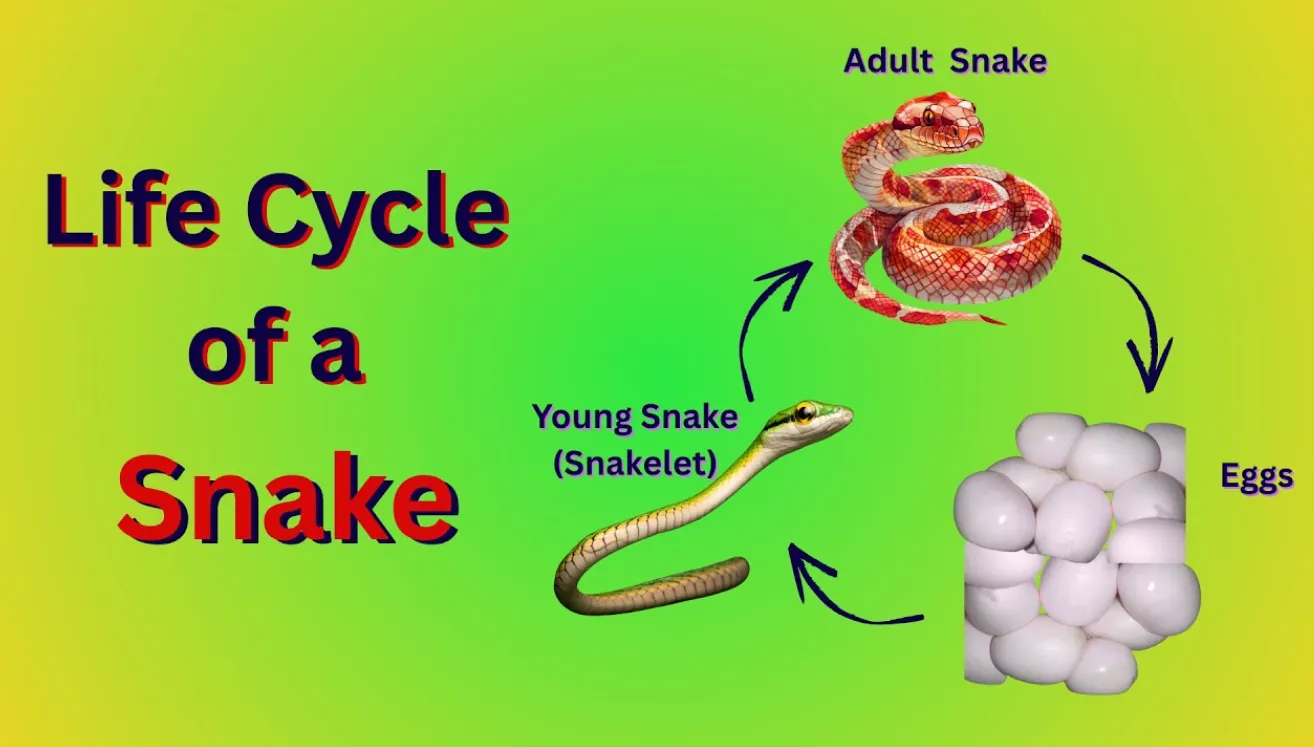
The life cycle of a snake is one of the most fascinating stories in the reptile world. From a small egg or live-born baby to a fully grown predator, a snake passes through several clear stages: birth, juvenile growth, shedding, maturity, reproduction, and old age. Although snakes may look mysterious, their life processes are closely linked to temperature, habitat, food availability, and survival skills.
Snakes belong to the reptilian group and are known for their legless bodies, flexible jaws, forked tongues, scales, and silent hunting. Some species lay eggs, while others give birth to live young. Many baby snakes are independent almost immediately after birth, which makes their survival journey tough from the very beginning.
Understanding snakes helps us see them not only as feared animals but also as important members of nature. They control rodents, maintain the balance of the food chain, and support healthy ecosystems. Modern references classify snakes as Serpentes within the order Squamata and describe them as highly specialized reptiles with more than 3,400 recognized species.
Q: What are the main stages in the life cycle of a snake?
A: The main stages are egg or live birth, hatchling/newborn, juvenile, adult, reproduction, and old age.
Q: Do all snakes lay eggs?
A: No. Many snakes lay eggs, but some species give birth to live young or keep eggs inside the body until birth. Around 70% of snakes are egg-laying species.
Q: Are baby snakes dependent on their parents?
A: Usually no. Most newborn snakes can move, hide, hunt small prey, and protect themselves soon after birth.
Quick Life Cycle Table
| Stage | What Happens | Key Details |
| Egg or Live Birth | Snake begins life inside an egg or is born live | Depends on species |
| Hatchling/Newborn | Baby snake comes out fully formed | Usually independent |
| Juvenile Stage | Rapid growth and frequent shedding | Hunts small prey |
| Adult Stage | Fully grown and sexually mature | Hunts, defends, and breeds |
| Reproductive Stage | Mating, egg-laying, or live birth | Seasonal in many species |
| Old Age | Slower movement and lower breeding activity | Lifespan varies by species |

The History of Their Scientific Naming
The scientific naming of snakes is based on biological classification, in which animals are grouped by shared body structure, ancestry, and evolutionary relationships. Snakes are commonly placed in the order Serpentes, a name derived from the Latin word meaning “creeping” or “crawling.” This name reflects the snake’s most visible feature: a long, limbless body that moves close to the ground.
In modern taxonomy, snakes are classified within Reptilia, under the order Squamata, the same broad order that includes lizards. This is important because snakes are not separate from lizards in evolutionary history; they are deeply connected to lizard ancestors.
Scientific names help researchers identify exact species. For example, a king cobra is known as Ophiophagus hannah, while many rat snake species belong to genera such as Pantherophis or Ptyas, depending on the region. The scientific system avoids confusion because common names can vary from country to country.
This naming history also helps conservationists, doctors, and wildlife workers correctly identify venomous and non-venomous species.
Their Evolution And Their Origin
The origin of snakes goes back millions of years. Modern science suggests that snakes evolved from ancient lizard-like reptiles. Over time, their ancestors gradually lost limbs and developed long, flexible bodies that helped them move through soil, leaf litter, rocks, grasslands, forests, and water.
One important evolutionary change was the loss of external limbs. This did not make snakes weaker; instead, it helped them become highly efficient movers in narrow spaces. Their bodies became specialized for crawling, climbing, swimming, burrowing, and ambushing prey.
Fossil evidence also shows that early snakes may have appeared during the Middle Jurassic Period, around 174.1 to 163.5 million years ago. One of the oldest known fossil snakes, Eophis underwoodi, lived about 167 million years ago.
Another major adaptation was the development of a flexible skull and jaws. Unlike humans, snakes can move parts of their jaw independently, allowing them to swallow prey larger than their head. Many species also developed advanced hunting tools such as venom, heat-sensing pits, strong muscles, camouflage, and chemical detection through the tongue.
Their evolution made snakes successful in deserts, wetlands, forests, farms, mountains, and even urban areas. This long evolutionary journey explains why snakes are found on almost every continent except Antarctica.
Important Things That You Need To Know
Snakes are not all the same. Different species have different habits, diets, defenses, and roles in nature. For example, the hognose snake is famous for its upturned nose and dramatic defense behavior. When threatened, it may flatten its neck, hiss, or even play dead. Most hognose snakes are not dangerous to humans, but they are excellent hunters of amphibians and small animals.
The rat snake is one of the most useful snakes around farms and human settlements because it eats rats and mice. By controlling rodents, rat snakes help reduce crop damage and disease risks.
The coral snake is known for its bright warning colors and powerful venom. However, coral snakes are usually secretive and avoid humans. Their colorful pattern reminds people that not all beautiful animals are safe to touch.
The king snake is especially interesting because some species can eat other snakes, including venomous ones. This gives them an important place in the food chain.
The phrase snake eyes is often used in games and culture, but real snake eyes are biologically special. Snakes do not blink because they lack movable eyelids. Instead, each eye is protected by a clear lens called a spectacle or a pair of glasses. This gives snakes their steady, staring look.
Their main food and its collection process
Snakes are carnivorous animals, meaning they eat other animals. Their food depends on size, species, habitat, and hunting style. Small snakes may eat insects, worms, frogs, lizards, small fish, or baby mice. Larger snakes may eat rodents, birds, eggs, rabbits, bats, and sometimes other reptiles.
Their food collection process begins with detection. Snakes use their forked tongue to collect scent particles from the air and ground. These particles are transferred to the Jacobson’s organ, a special sensory organ in the roof of the mouth. This helps the snake understand where prey, predators, or mates may be located.
Some snakes also use body heat detection. Pit vipers, some boas, and pythons have heat-sensitive organs that help them detect warm-blooded prey in darkness. This makes them powerful night hunters.
Common feeding methods include:
- Ambush hunting: The snake waits silently and strikes when prey comes close.
- Active searching: The snake moves through grass, holes, trees, or water to find prey.
- Constriction: Species like pythons and boas wrap around prey and stop its breathing.
- Venom injection: Venomous snakes use modified saliva to weaken or kill prey.
- Swallowing whole: Snakes do not chew. They swallow prey whole using flexible jaws.
After eating, a snake may rest for days or weeks while digestion takes place.

Their life cycle and ability to survive in nature
Birth or Hatching Stage
A snake’s life begins either in an egg or through live birth. Egg-laying species deposit eggs in warm, hidden places such as soil, leaf litter, rotting logs, burrows, or moist shelters. Live-bearing species give birth to fully formed young.
The incubation period depends on species and temperature. For example, some pine snakes have eggs that may incubate for around 51 to 100 days.
Hatchling or Newborn Stage
A newborn snake is small but already shaped like an adult. It can crawl, flick its tongue, hide, and search for tiny prey. This stage is dangerous because birds, mammals, larger snakes, frogs, and even insects may attack young snakes.
Juvenile Stage
During the juvenile period, snakes grow quickly. They shed their skin many times because their outer scale layer does not grow with the body. Each shed allows the snake to remove old skin and continue growing.
Adult Stage
Adult snakes focus on survival and reproduction. They develop stronger hunting skills, better territory awareness, and seasonal breeding behavior. Their survival depends on camouflage, silence, fast strikes, hiding ability, and energy-saving movement.
Their Reproductive Process and raising their children
Snake reproduction differs from that of many mammals because most species do not care for their young for long. The process usually begins when males search for females during the breeding season. They use scent trails and chemical signals to locate a mate.
Important steps in snake reproduction include:
- Mating season: Many snakes breed during warmer months, though the timing varies by climate and species.
- Male competition: In some species, males wrestle or push each other to win access to a female.
- Internal fertilization: Like other reptiles, snakes reproduce through internal fertilization.
- Egg-laying or live birth: Some species lay eggs, while others give birth to live young.
- Hidden nesting sites: Egg-laying snakes often choose warm, moist, protected places.
Most female snakes leave after laying eggs. However, there are exceptions. Some python species coil around their eggs to protect and warm them. Smithsonian’s information on black-headed pythons notes that females may lay 8 to 18 eggs and warm them by curling around the clutch.
Baby snakes usually receive little or no parental care. They are born with instincts to hide, hunt, and avoid predators. Even venomous newborn snakes may already have venom, though their size makes them vulnerable.
The importance of them in this Ecosystem
Natural Pest Control
Snakes are important because they control populations of rats, mice, frogs, insects, and other small animals. In farms, forests, and wetlands, this natural pest control helps protect crops and reduces the imbalance in the food chain.
A healthy snake population can prevent prey species from increasing to unnatural levels. Government wildlife guidance also notes that snakes are important middle-order predators that help maintain natural ecosystems.
Food Chain Balance
Snakes are both predators and prey. They eat smaller animals, but hawks, eagles, mongooses, wild cats, larger snakes, and other predators also eat them. This makes them a key link in energy transfer within ecosystems.
Biodiversity Protection
Snakes are part of global biodiversity. When snakes disappear, it can signal deeper environmental problems such as habitat destruction, pollution, overhunting, or loss of prey species.
Medical and Scientific Value
Snake venom has helped researchers study blood clotting, nerve function, pain, and the development of new medicines. Although venom can be dangerous, it also has scientific value when studied safely.
Reducing Human-Wildlife Conflict
Understanding snakes helps reduce unnecessary killing. Most snakes do not attack people unless threatened. Education allows people to live more safely near wildlife.
What to do to protect them in nature and save the system for the future
Protecting snakes means protecting the balance of nature. Many snakes die because of fear, habitat loss, road accidents, pollution, and illegal wildlife trade. Simple actions can make a major difference.
- Do not kill snakes unnecessarily. Most snakes avoid humans and only become defensive when threatened.
- Protect natural habitats. Forests, wetlands, grasslands, farms, and riverbanks provide shelter, prey, and breeding sites.
- Keep the environment clean. Plastic waste, chemical pollution, and pesticides harm snakes and their prey.
- Avoid using excessive rodent poison. Poisoned rodents can be eaten by snakes, causing secondary poisoning.
- Call trained rescuers. If a snake enters a home or workplace, contact a local wildlife rescue or trained handlers rather than trying to kill it.
- Learn local species. Knowing the difference between venomous and non-venomous snakes can prevent panic.
- Protect nesting areas. Do not destroy burrows, rotten logs, or leaf piles in natural zones without reason.
- Drive carefully in rural areas. Many snakes are killed on roads, especially during warm evenings.
- Teach children safe behavior. Children should learn not to touch, chase, or throw stones at snakes.
- Support conservation awareness. Community education can reduce fear and protect biodiversity.
Saving snakes does not mean bringing them close to humans. It means respecting their natural place and allowing ecosystems to stay balanced.

Frequently Asked Questions (FAQs)
Q1: What is the life cycle of a snake?
A: The life cycle includes egg or live birth, newborn stage, juvenile growth, adult maturity, reproduction, and old age. Each stage depends on species, climate, food, and habitat.
Q2: How long does it take for snake eggs to hatch?
A: It varies by species and temperature. Some snake eggs hatch in about 45 to 90 days, while others may take longer. Warm, stable conditions usually support better development.
Q3: Do baby snakes stay with their mother?
A: Usually no. Most baby snakes are independent soon after hatching or birth. Some python species are exceptions, as females may protect or warm the eggs for a period.
Q4: What do baby snakes eat?
A: Baby snakes eat small prey such as insects, frogs, lizards, worms, fish, or newborn mice, depending on species and habitat.
Q5: How do snakes grow?
A: Snakes grow by eating and shedding their skin. Young snakes shed more often because they grow quickly. Adults shed less frequently.
Q6: Do all snakes have venom?
A: No. Many snakes are non-venomous. Some kill prey by constriction, some swallow small prey alive, and only certain species use venom to hunt or defend themselves.
Q7: Why are snakes important to humans?
A: Snakes help control rodents, protect crops, support biodiversity, and contribute to scientific research. They are useful even when people fear them.
Q8: What should I do if I see a snake?
A: Stay calm, keep distance, do not touch it, and allow it to move away. If it is inside a home, call a trained snake rescuer or local wildlife authority.
Conclusion
The life cycle of a snake shows how powerful and well-adapted these reptiles are. From a tiny hatchling or newborn to a skilled adult predator, every stage is shaped by survival, hunting, growth, and reproduction. Snakes may not raise their young like mammals, but their babies are born with strong instincts that help them live independently.
Snakes are more than frightening animals in stories. They are valuable predators, natural pest controllers, and important parts of the food chain. Species such as rat snakes, king snakes, coral snakes, and hognose snakes all play different roles in nature.
Protecting snakes means protecting biodiversity, farms, forests, and ecological balance. When people understand snakes better, fear becomes respect. A safe future for snakes is also a healthier future for the Ecosystem they help maintain.
Also Read: house fly life cycle
About the Author