The lion’s life cycle is a fascinating journey that reflects strength, survival, and adaptation in the wild. Known as the “King of the Jungle,” the lion is among the most iconic predators on Earth. Their life cycle—from birth as helpless cubs to becoming dominant hunters—plays a crucial role in maintaining ecological Balance.
Lions primarily inhabit the grasslands and savannas of Africa, with a small population in India. Understanding their life cycle helps us appreciate how they grow, hunt, reproduce, and survive in challenging environments. It also highlights the importance of conservation efforts to protect these majestic animals.
Unlike solitary cats, lions live in social groups called prides. This unique behavior affects every stage of their life cycle, from cub protection to hunting strategies. Environmental factors, food availability, and social hierarchy influence their development.
🔎 Quick Answers (Most Common Questions)
1. What are the stages of the lion’s life cycle?
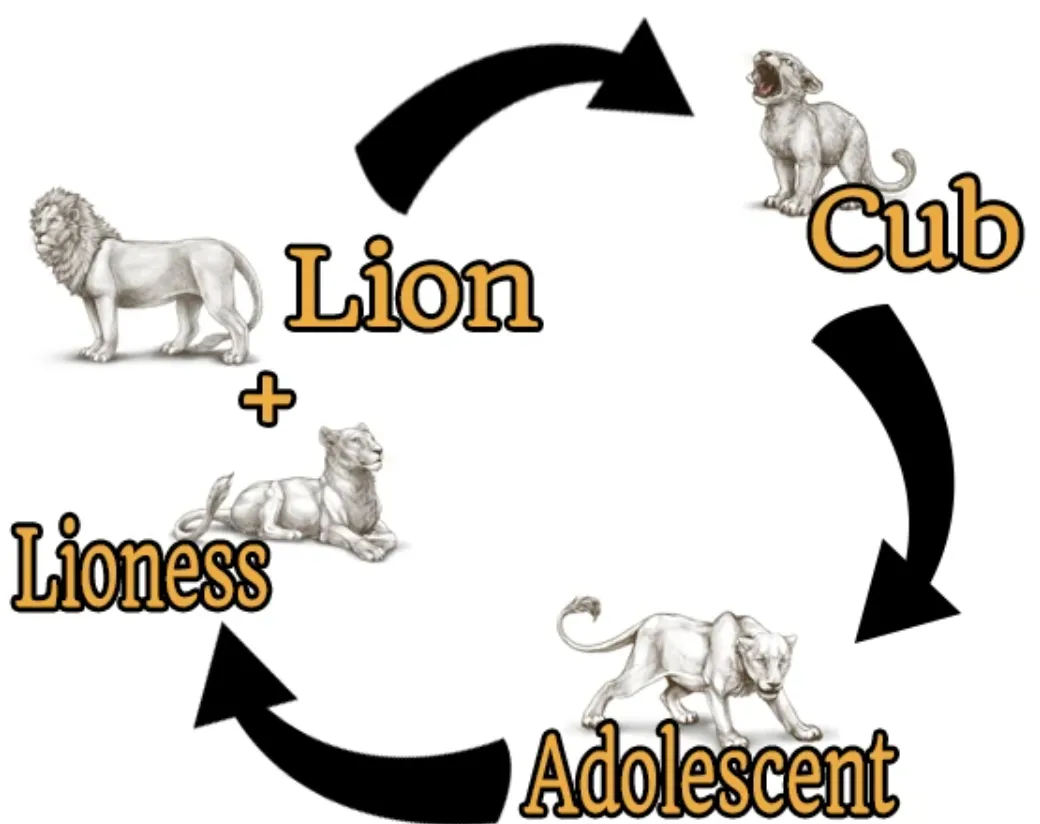
The lion’s life cycle includes birth (cub), adolescence (subadult), adulthood, reproduction, and aging.
2. How long do lions live?
Lions typically live 10–14 years in the wild and up to 20 years in captivity.
3. When do lion cubs become independent?
Cubs usually become independent around 2–3 years of age.
Quick Life Cycle Table
| Stage | Age Range | Key Characteristics |
| Cub | 0–1 year | Blind at birth, fully dependent on mother |
| Juvenile | 1–2 years | Learning to hunt and socialize |
| Subadult | 2–3 years | Developing strength, males may leave pride |
| Adult | 3–10 years | Hunting, mating, leading pride |
| Senior | 10+ years | Reduced strength, vulnerable |

The History Of Their Scientific Naming
The scientific naming of lions has a rich history rooted in taxonomy and biological classification.
- The lion’s scientific name is Panthera leo, assigned by Carl Linnaeus in 1758.
- “Panthera” refers to the genus that includes big cats like tigers and leopards.
- “Leo” comes from Latin, meaning lion, reflecting its long-recognized identity.
- Early classifications grouped lions with other large carnivores before modern genetics refined their placement.
- Subspecies such as Panthera leo leo (African lions) and Panthera leo persica (Asiatic lions) were later identified.
- Scientific naming evolved as researchers studied skull structure, behavior, and DNA.
- Modern taxonomy now relies heavily on genetic data rather than just physical traits.
This classification helps scientists understand lion evolution, distribution, and conservation needs worldwide.
Their Evolution And Their Origin
Lions have a long evolutionary history dating back millions of years. Fossil records show that early lion-like species appeared around 2 million years ago during the Pleistocene epoch.
Ancient lions, such as the Eurasian cave lion (Panthera spelaea), were larger than modern lions and roamed across Europe and Asia. Over time, environmental changes and human activity led to their extinction.
Modern lions evolved in Africa and gradually spread to parts of Asia and Europe. Today, their range is much smaller due to habitat loss and hunting.
Key evolutionary adaptations include:
- Strong jaws and sharp teeth for hunting large prey
- Social behavior (prides), which is rare among big cats
- Male development in males, which may signal dominance and attractiveness
- Enhanced night vision for hunting in low light
Genetic studies suggest that African and Asiatic lions diverged thousands of years ago. Asiatic lions, now found only in India’s Gir Forest, are smaller and have slight physical differences.
Despite their powerful adaptations, lions face threats from habitat fragmentation and climate change. Their evolution continues to be shaped by human impact and environmental pressures.
Important Things That You Need To Know
The world of lions is not just about survival—it also includes cultural significance, artistic inspiration, and storytelling. Let’s explore some interesting aspects of LSI keywords.
🦁 Lion
The lion symbolizes power, courage, and leadership. It is often used in national emblems, flags, and folklore across many cultures.
🎨 Lion Drawing
A lion drawing is a popular artistic subject due to its majestic appearance. Artists often focus on the mane, facial expression, and muscular body to capture realism.
Drawing lions also helps students understand anatomy, proportions, and wildlife art techniques.
🦁 Scar Lion King
Scar, from The Lion King, is one of the most famous fictional lions. In Disney’s The Lion King, Scar represents cunning and ambition. His character contrasts with the natural pride dynamics seen in real lions.
🌍 Cultural Importance
Lions appear in myths, literature, and movies, making them globally recognized symbols. Their presence in storytelling helps raise awareness about wildlife conservation.
🧠 Educational Value
Learning about lions through art and media increases interest in biology and environmental science. It encourages people to protect wildlife habitats.
These elements show how lions are not only biological wonders but also cultural icons that inspire creativity and awareness.
Their Main Food and Its Collection Process
Lions are carnivorous predators, meaning their diet consists entirely of meat. Their hunting strategy is highly organized and depends on teamwork.
🥩 Main Food Sources
- Zebras
- Wildebeests
- Buffalo
- Antelopes
- Occasionally, smaller animals like hares
🎯 Hunting Process
- Group Hunting: Female lions usually hunt together to increase success rates.
- Stalking: They quietly approach prey using tall grass as cover.
- Ambush Attack: Lions rely on speed and strength to overpower prey.
- Targeting Weak Prey: They often choose injured, old, or young animals.
- Killing Method: A bite to the throat suffocates the prey.
🍖 Food Sharing
- Dominant males eat first
- Females and cubs eat afterward
- Food scarcity can lead to competition
This efficient hunting system ensures survival in harsh environments.

Their Life Cycle and Ability to Survive in Nature
🐾 Birth and Early Life
Lion cubs are born blind and helpless. They rely entirely on their mother for food and protection.
🐾 Growth and Learning
Cubs begin eating meat around 3 months old. They learn hunting skills by observing adults.
🐾 Adolescence
Young lions develop strength and social skills. Male lions often leave the pride during this stage.
🐾 Adulthood
Adult lions become skilled hunters and leaders. Males defend territory, while females hunt.
🐾 Survival Strategies
- Living in pride for protection
- Hunting cooperatively
- Adapting to different environments
- Strong social bonds
These abilities help lions survive despite environmental challenges.
Their Reproductive Process and Raising Their Children
Lions have a unique reproductive system influenced by pride dynamics.
🐣 Reproduction Process
- Mating can occur year-round
- Gestation lasts about 110 days
- Females give birth to 2–4 cubs
🍼 Raising Cubs
- Cubs are hidden in dens for safety
- Mothers nurse cubs for several months
- Other females may help care for cubs
🛡️ Protection
- Mothers are highly protective
- Male lions defend the pride from threats
⚠️ Challenges
- High cub mortality rate
- Threats from predators and rival males
Despite challenges, strong maternal care increases the chances of survival.
Importance of Them in this Ecosystem
🌿 Maintaining Balance
Lions control herbivore populations, preventing overgrazing.
🔄 Food Chain Role
They are apex predators, sitting at the top of the food chain.
🌍 Biodiversity Support
By regulating prey species, lions help maintain ecosystem diversity.
🧬 Indicator Species
Healthy lion populations indicate a balanced ecosystem.
Their presence is essential for ecological stability.
What to Do to Protect Them in Nature and Save the System for the Future
- Protect natural habitats from deforestation
- Prevent illegal hunting and poaching
- Support wildlife conservation programs
- Promote eco-tourism responsibly
- Educate communities about lion conservation
- Reduce human-wildlife conflict
- Enforce stricter wildlife laws
- Support organizations working for lion protection
Conservation efforts are crucial to ensure lions thrive in the future.

Frequently Asked Questions (FAQs)
1. How long is the lion’s life cycle?
It typically lasts 10–14 years in the wild.
2. What do lion cubs eat?
They start with milk and later transition to meat.
3. Why do male lions leave the pride?
To establish their own territory and avoid competition.
4. How many cubs can a lion have?
Usually, 2–4 cubs per birth.
5. Are lions endangered?
Yes, lions are considered vulnerable due to habitat loss.
6. Do lions hunt alone or in groups?
Mostly in groups, especially females.
7. What is the role of male lions?
They protect the pride and territory.
8. Where do lions live today?
Mostly in Africa, with a small population in India.
Conclusion
The lion’s life cycle is a powerful example of nature’s Balance, showcasing growth, survival, and adaptation. From vulnerable cubs to dominant adults, lions undergo remarkable transformations that define their role as apex predators.
Their social structure, hunting strategies, and reproductive behaviors highlight their uniqueness among big cats. However, modern challenges like habitat loss and human conflict threaten their survival.
Understanding their life cycle is not just about knowledge—it’s about responsibility. Protecting lions ensures the health of ecosystems and preserves biodiversity for future generations.
Also Read About: life cycle of the panda
About the Author