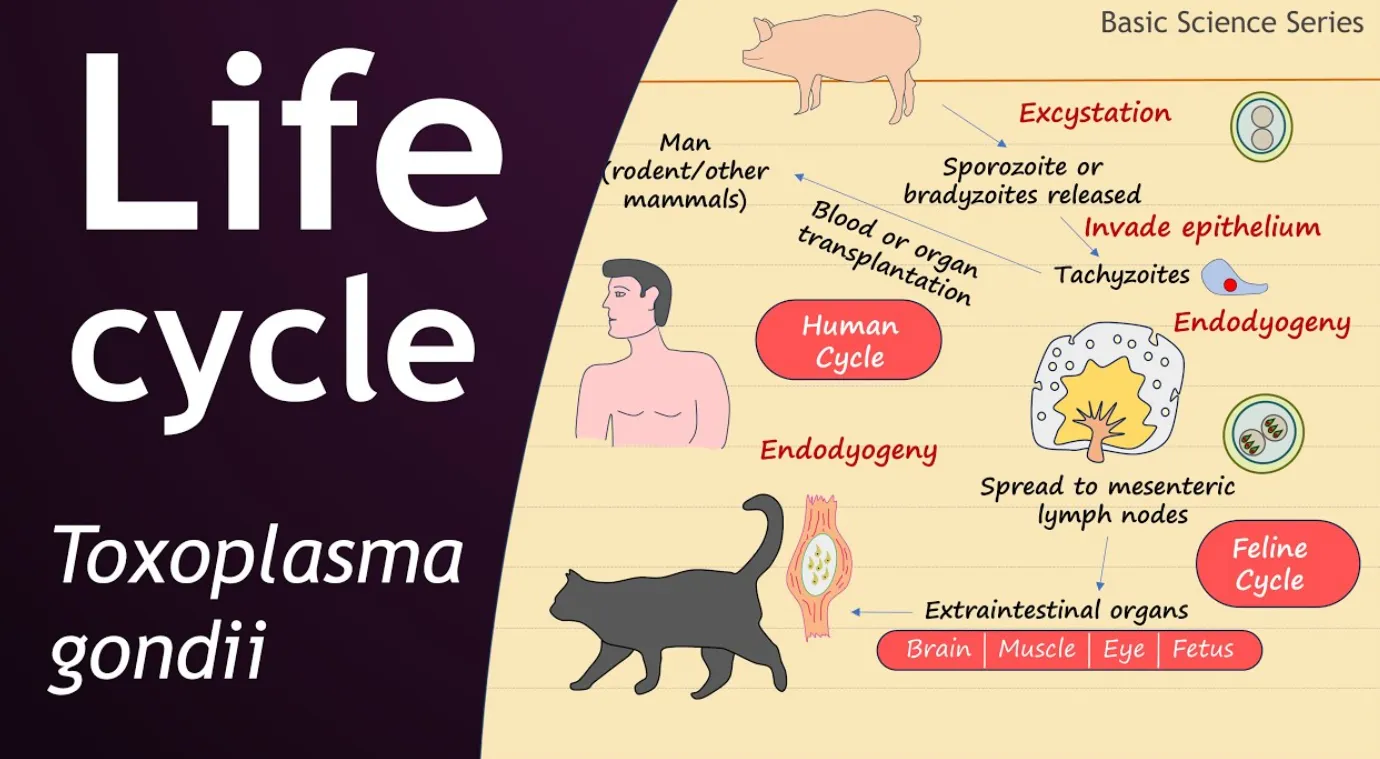
The life cycle of Toxoplasma gondii is one of the most fascinating and important topics in parasitology because this tiny parasite connects cats, soil, water, meat, wildlife, and humans into a complex biological system. Toxoplasma gondii is a single-celled protozoan parasite that can infect most warm-blooded animals, including birds, livestock, wild animals, pets, and humans. The disease caused by this parasite is called toxoplasmosis.
The most important thing to understand is that cats and other members of the Felidae family are the only known definitive hosts. This means the sexual stage of the parasite happens inside cats. Humans, birds, rodents, sheep, pigs, and many other animals are usually intermediate hosts, where the parasite forms tissue cysts and remains dormant for long periods.
For most healthy people, infection may cause no symptoms at all. Some people may develop flu-like symptoms, such as swollen lymph nodes, fever, headache, and muscle pain. The infection becomes more serious during pregnancy, in newborn babies, in people with weakened immune systems, and sometimes when the eyes are affected.
Q: What is the main host in the Toxoplasma gondii life cycle?
A: The main host is the cat. Domestic cats and wild cats are the only known hosts where Toxoplasma gondii completes sexual reproduction and produces oocysts.
Q: Can humans get Toxoplasma gondii from food?
A: Yes. Humans can become infected by eating undercooked meat containing tissue cysts, drinking or eating contaminated food or water, or accidentally swallowing soil or dust contaminated with cat feces.
Q: Can you get rid of Toxoplasma gondii naturally?
A: There is no proven natural method that reliably removes Toxoplasma gondii from the body. Natural steps can reduce exposure and support general health, but suspected infection, pregnancy-related exposure, eye symptoms, or immune weakness require medical care.
Quick Life Cycle Table
| Life cycle stage | Where it happens | What happens | Why it matters |
| Sexual stage | Cat intestine | The parasite reproduces sexually and creates oocysts | Cats are the only known definitive hosts |
| Oocyst shedding | Cat feces | Newly infected cats can shed large numbers of oocysts for a short period | Fresh feces are not instantly infective |
| Sporulation | Soil, water, litter, and garden areas | Oocysts become infective after about 1 to 5 days in the environment | This is why daily litter cleaning lowers risk |
| Intermediate host infection | Birds, rodents, livestock, humans | Hosts swallow infective oocysts from soil, food, or water | The parasite spreads through nature and food chains |
| Tachyzoite stage | Body cells | Fast multiplying form spreads through tissues | This stage is linked with acute infection |
| Bradyzoite tissue cysts | Brain, eye, heart, skeletal muscle | Slow-growing forms stay inside tissue cysts | Cysts can remain for life in many hosts |
| Cat reinfection | A cat eats infected prey or raw meat | Tissue cysts restart the cycle inside the cat | Hunting and raw meat feeding increase the risk of cat infection |

Important Things That You Need To Know
Many people search for toxoplasma gondii, toxoplasma gondii symptoms, toxoplasma gondii treatment, toxoplasma gondii life cycle diagram, how to get rid of toxoplasma gondii naturally, and toxoplasma gondii in humans because this parasite sounds simple at first. Still, it has a very deep connection with health, food safety, pregnancy, and ecology.
The first important point is that Toxoplasma gondii in humans is common worldwide, but most healthy people never know they have been infected. The immune system usually controls the parasite, pushing it into a quiet cyst stage. Still, quiet does not always mean gone. In some people with weakened immunity, an old infection can reactivate and cause serious disease.
Second, the symptoms of Toxoplasma gondii vary from person to person. Healthy adults may have no symptoms or mild fever, swollen lymph nodes, headache, and muscle aches. Eye infection can cause eye pain, poor vision, and floaters. Severe infection can affect the brain, lungs, or fetus during pregnancy.
Third, Toxoplasma gondii treatment depends on the individual and the severity of the infection. Many mild infections in healthy people do not need medicine, but serious diseases, pregnancy-related infections, congenital infections, and immunocompromised patients may need prescribed antiparasitic drugs.
Fourth, a Toxoplasma gondii life cycle diagram is useful because it shows one key truth: cats release oocysts, the environment spreads them, animals form tissue cysts, and cats restart the cycle by eating infected prey.
Finally, when people ask how to get rid of Toxoplasma gondii naturally, the safer answer is prevention, not self-treatment. Cook meat well, wash produce, avoid untreated water, clean litter daily with gloves, and speak with a clinician if risk is high.
The History of Their Scientific Naming
• Toxoplasma gondii was first described in the early twentieth century during parasite research involving a North African rodent called the gundi.
• The name is linked to two major researchers, Charles Nicolle and Louis Manceaux, who published the formal description of the organism in 1909 after observing it in tissues of Ctenodactylus gondii.
• The word Toxoplasma comes from Greek roots connected with a bow or curved shape and something molded. This name reflects the parasite’s arc-like shape.
• The species word gondii comes from the gundi rodent in which the parasite was discovered.
• At first, scientists thought the organism might be related to Leishmania, another protozoan parasite. Later, they realized it was different enough to deserve its own genus.
• Around the same period, Alfonso Splendore found a similar organism in a rabbit in Brazil. This showed that the parasite was not confined to a single place or animal.
The naming history matters because it shows how scientific understanding grows slowly. What looked like a small, unknown parasite later became one of the most-studied parasites in the world.
Their Evolution And Their Origin
The origin of Toxoplasma gondii is deeply tied to the evolution of Apicomplexa, a large group of parasites that includes organisms such as Plasmodium, the malaria parasite. These parasites share special cell structures that help them enter host cells and survive inside them. Toxoplasma gondii is especially successful because it can infect almost any nucleated cell in many warm-blooded animals.
Modern research suggests that the global success of T. gondii is closely linked with cats. Scientific studies describe Toxoplasma gondii as a cyst-forming apicomplexan parasite that infects nearly all warm-blooded species, with true cats as its definitive hosts. Research also connects the spread of important T. gondii lineages with the history and movement of wildcats and domestic cats.
This relationship gave the parasite a powerful survival advantage. Cats hunt rodents and birds. Rodents and birds become infected from the environment. Cats then eat infected prey and release new oocysts. This creates a cycle that moves through soil, water, prey animals, and predators.
Another key part of its evolution is flexibility. Toxoplasma gondii can reproduce sexually in cats, but it can also spread asexually in intermediate hosts. This means it does not need to find a cat immediately to survive. It can hide in tissue cysts inside animals for long periods.
Its origin is not just one simple event. It is the result of parasite adaptation, predator-prey relationships, host cell invasion, environmental resistance, and the long history of cats living near humans.

Their main food and its collection process
Toxoplasma gondii does not eat like an animal. It has no mouth, teeth, stomach, or digestive system like larger organisms. It is an obligate intracellular parasite, meaning it must live within host cells during key stages of its life. Its “food” is better understood as nutrients taken from the host cell.
• Host cell nutrients: The parasite takes amino acids, lipids, sugars, vitamins, and other metabolites from the cell it infects. These nutrients help it grow, divide, and build new parasite cells.
• Nutrient transporters: Current research shows that membrane transporters are important for T. gondii because they help acquire nutrients from host cells, regulate ions, and maintain metabolic balance. Many of these transporters are still not fully understood, which makes them important targets for future drug research.
• Parasitophorous vacuole: After entering a host cell, the parasite creates a protected space called a parasitophorous vacuole. This helps it avoid some immune attacks while still gaining access to host resources.
• Apicoplast metabolism: Toxoplasma gondii also has a special organelle called the apicoplast. It no longer performs photosynthesis, but it keeps important metabolic pathways that support parasite survival and replication.
• Tissue cyst survival: In the bradyzoite stage, the parasite slows down. It uses fewer resources and survives inside tissue cysts, especially in the brain, eye, heart, and muscle tissue.
So, its “food collection process” is really a smart biological stealing system. It invades a cell, creates a protected niche, controls the local environment, and pulls nutrients from the host for growth.
Their life cycle and ability to survive in nature
The cat stage
The Toxoplasma gondii life cycle begins most completely in cats. Cats become infected when they eat infected prey, raw meat, or sometimes sporulated oocysts from the environment. Inside the cat intestine, the parasite reproduces sexually and creates oocysts.
The environment stage
Fresh oocysts are usually not infective immediately. They need time in soil, litter, sand, water, or moist outdoor areas to mature. This process is called sporulation. Oocysts can become infective after 1 to 5 days in the environment.
This is one reason daily litter box cleaning is useful. Removing feces before oocysts mature can reduce risk.
The intermediate host stage
Birds, rodents, livestock, and humans become infected when they swallow mature oocysts from contaminated soil, water, plants, or food. After ingestion, the parasite becomes tachyzoites, the fast-multiplying stage. Later, it changes into bradyzoites, the slow stage inside tissue cysts. These cysts can remain in the host for life.
Survival power in nature
The parasite survives through three strong strategies: environmental oocysts, tissue cysts, and predator-prey transmission. Oocysts help it move through soil and water. Tissue cysts help it to survive inside animals. Cats restart the sexual cycle when they eat infected prey. This makes T. gondii highly successful in farms, forests, cities, and coastal environments.
Their Reproductive Process and raising their children
Toxoplasma gondii does not raise children like birds, mammals, or insects. It produces new parasite stages. So the “raising” process is better explained as development, multiplication, and transmission.
• Sexual reproduction in cats: The only known sexual reproduction stage happens in the intestine of cats and other felids. The parasite forms male and female-like reproductive stages, then produces oocysts.
• Oocyst production: Infected cats can shed large numbers of oocysts in feces. Newly exposed cats may begin shedding after consuming infected tissue and continue shedding for 10 to 14 days. Public health sources also describe typical shedding for about 1 to 3 weeks.
• Environmental development: Oocysts are not fully ready at first. They mature in the environment through sporulation. After this stage, they become infective to birds, rodents, livestock, and humans.
• Asexual reproduction in intermediate hosts: Once inside an intermediate host, the parasite becomes tachyzoites. These multiply rapidly within cells and spread throughout the body.
• Cyst formation: When the immune system responds, tachyzoites convert into bradyzoites. These form tissue cysts and survive quietly.
• Transmission to the next host: If a cat eats an infected rodent or bird, the tissue cysts open inside the cat’s intestine. This starts sexual reproduction again.
This reproductive strategy is efficient because it does not depend on one path. The parasite can move through food, soil, water, prey, and, rarely, medical routes such as transplant or transfusion.
The importance of them in this Ecosystem
A parasite with ecological influence
Toxoplasma gondii is not “important” in the same way as bees, trees, or decomposers. It is a parasite that can harm animals and humans. Still, it plays a real role in ecosystems because it affects predator-prey relationships, wildlife health, cat populations, soil contamination, and disease transmission.
Role in predator-prey cycles
The life cycle depends heavily on cats eating infected prey. Rodents and birds can become infected from soil, water, or plants contaminated with oocysts. When cats eat them, the parasite returns to its definitive host. This links T. gondii with natural hunting behavior.
Some studies have examined whether infection alters animal behavior, particularly in rodents, increasing their likelihood of encountering cats. This topic is still studied carefully because behavior, immunity, environment, and parasite strain all matter.
Wildlife and water systems
The parasite can move from land to water when rain carries contaminated soil or fecal material into streams, rivers, or coastal areas. Water and sanitation research recognizes T. gondii as important because oocysts can be transmitted through contaminated food and water and may persist in water systems.
Public health importance
From an ecosystem perspective, Toxoplasma gondii reminds us that human, animal, and environmental health are interconnected. Outdoor cats, livestock practices, food handling, wildlife exposure, sanitation, and water safety all shape the risk.
So, the ecosystem importance of this parasite is not about protecting the parasite itself. It is about understanding its place in nature so humans can reduce harmful spread without damaging the wider system.
What to do to protect them in nature and save the system for the future
For Toxoplasma gondii, “protect them” should not mean increasing the parasite. The better goal is to protect the natural system by reducing unsafe spread, protecting wildlife, keeping cats healthy, improving food safety, and lowering human infection risk.
• Keep pet cats indoors when possible. Indoor cats are less likely to hunt infected rodents or birds and less likely to spread oocysts outdoors.
• Do not feed cats raw or undercooked meat. Commercial cat food lowers the chance of cats becoming infected through tissue cysts.
• Clean cat litter daily. Oocysts need time to become infective, so daily cleaning helps reduce risk. Wear gloves and wash your hands afterward.
• Pregnant people and people with weak immune systems should avoid cleaning litter boxes when possible. If they must clean them, gloves and careful hand washing are important.
• Cover sandboxes and garden soil areas where cats may defecate. This protects children, gardeners, and nearby wildlife.
• Wash fruits and vegetables under running water before eating. Soil contamination is one of the quiet ways oocysts can enter food.
• Cook meat to safe internal temperatures. Use a food thermometer because color and texture are not reliable safety signs.
• Avoid untreated water, especially in areas where sanitation is poor, or cat fecal contamination is possible.
• Support responsible stray cat management. Spaying, neutering, vaccination, and humane population control can reduce environmental contamination.
• Protect wetlands, streams, and coastal areas from fecal runoff. Better sanitation protects humans, livestock, and wildlife simultaneously.
These steps do not destroy nature. They help balance human safety, cat welfare, wildlife protection, and clean environments.

Frequently Asked Questions
Q: What is the Toxoplasma gondii life cycle in simple words?
A: The life cycle starts in cats, where the parasite reproduces sexually and produces oocysts. These oocysts are shed in the cat’s feces, mature in the environment, and infect birds, rodents, livestock, or humans. In intermediate hosts, the parasite forms tissue cysts. Cats restart the cycle when they eat infected prey or raw meat.
Q: What are common Toxoplasma gondii symptoms?
A: Most people have no symptoms. Some develop fever, swollen lymph nodes, headache, muscle aches, fatigue, or sore throat. Eye infection may cause eye pain, blurred vision, floaters, or vision loss. Severe disease can affect the brain, lungs, or unborn baby.
Q: Is Toxoplasma gondii dangerous in humans?
A: It can be. In healthy people, it is often mild or silent. It is more dangerous during pregnancy, in newborns, in people with HIV or AIDS, in transplant patients, in cancer treatment patients, and in anyone taking immunosuppressant medicine.
Q: What is the best Toxoplasma gondii treatment?
A: Treatment depends on the case. Serious toxoplasmosis may be treated with medicines such as pyrimethamine, sulfadiazine, and folinic acid under medical supervision. Pregnancy and congenital cases need special expert care.
Q: Can I get rid of Toxoplasma Gondii naturally?
A: There is no proven natural cure that reliably removes Toxoplasma gondii tissue cysts from the body. Good nutrition, sleep, and hygiene support general health, but they are not a replacement for diagnosis or treatment. If you are pregnant, immunosuppressed, or have eye or brain symptoms, seek medical care.
Q: Do all cats spread Toxoplasma gondii?
A: No. Cats usually shed oocysts for a limited time after infection. Indoor cats that do not hunt and are not fed raw meat are less likely to become infected. The highest risk is from cats that hunt infected prey or eat raw infected meat.
Q: What does a Toxoplasma gondii life cycle diagram show?
A: A good diagram shows cats as definitive hosts, feces as the source of oocysts, soil and water as environmental spread points, animals as intermediate hosts, tissue cysts in meat, and humans as accidental intermediate hosts through food, water, soil, pregnancy, or rare medical transmission.
Q: How can I prevent Toxoplasma gondii infection?
A: Cook meat properly, wash fruits and vegetables, avoid untreated water, wear gloves while gardening, wash hands after soil contact, clean cat litter daily, avoid feeding cats raw meat, and take extra care during pregnancy or immune weakness.
Conclusion
The Toxoplasma gondii life cycle is a powerful example of how one tiny parasite can connect cats, prey animals, soil, water, food, and humans. Cats are the only known definitive hosts, while humans and many animals act as intermediate hosts. The parasite survives through strong life stages: oocysts, tachyzoites, and bradyzoite tissue cysts.
For SEO readers and real-life safety, the most useful lesson is simple. You do not need to fear every cat, but you do need smart hygiene. Cook meat thoroughly, wash produce, avoid untreated water, clean litter safely, and protect pregnant or immunocompromised people from exposure.
There is no proven natural way to remove Toxoplasma gondii from the body fully, so serious cases require medical guidance. Understanding this parasite helps protect people, cats, wildlife, and the wider Ecosystem with calm, science-based action.
Also Read: life cycle of the chicken
About the Author