The moth’s life cycle is one of the most fascinating natural processes in the insect world. Moths undergo a complete transformation known as metamorphosis, turning from tiny eggs into crawling larvae, then into pupae, and finally emerging as winged adults. With over 160,000 species worldwide, moths play a crucial role in ecosystems, pollination, and even scientific research.
Unlike butterflies, moths are mostly nocturnal, meaning they are active at night. This unique lifestyle influences everything—from what moths eat to how they reproduce and survive.
✅ Quick Answers (Most Common Questions)
1. What are the stages of the moth’s life cycle?
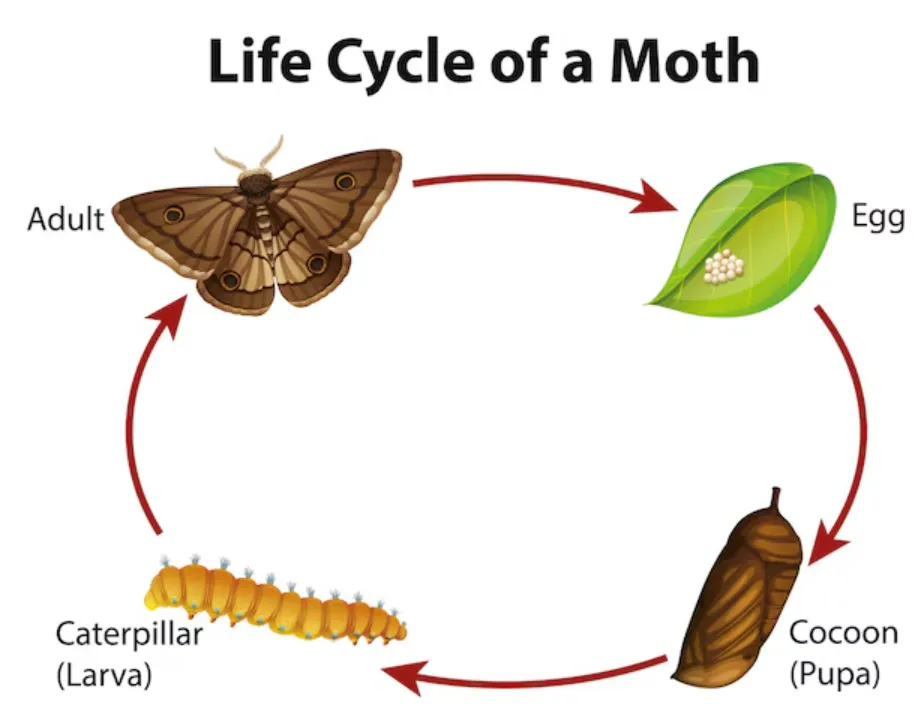
Moths go through four stages: egg → larva (caterpillar) → pupa (cocoon) → adult moth.
2. How long does a moth’s life cycle take?
It varies by species, but most moths complete their life cycle in 1 to 6 months.
3. What do moths eat during their life cycle?
Larvae eat leaves, fabrics, or stored food, while adult moths often feed on nectar—or sometimes don’t eat at all.
Quick Life Cycle Table
| Stage | Description | Duration (Approx.) |
| Egg | Tiny eggs are laid on plants or food sources | 3–10 days |
| Larva (Caterpillar) | Active feeding stage, rapid growth | 2–4 weeks |
| Pupa (Cocoon) | Transformation stage inside the cocoon | 1–3 weeks |
| Adult Moth | Reproduction and dispersal stage | A few days to weeks |

The History Of Their Scientific Naming
The scientific classification of moths has evolved over centuries as scientists discovered more about their diversity.
- Moths belong to the order Lepidoptera, which includes both moths and butterflies.
- The term “Lepidoptera” comes from Greek words meaning “scale” and “wing,” referring to the tiny scales on their wings.
- Early taxonomists grouped moths simply as “non-butterflies,” but modern science recognizes thousands of distinct families.
- Carl Linnaeus, the father of taxonomy, first classified many moth species in the 18th century.
- Today, moths are divided into numerous families such as Noctuidae, Geometridae, and Tineidae.
- Scientific naming follows binomial nomenclature (Genus + Species), helping researchers identify species globally.
- Advances in DNA analysis have refined moth classification, revealing evolutionary relationships.
This scientific framework allows researchers to study moth behavior, ecology, and evolution with precision.
Their Evolution And Their Origin
Moths are ancient insects with a history dating back over 200 million years, making them among the earliest pollinators on Earth.
Scientists believe moths evolved during the Jurassic period, long before flowering plants became widespread. Early moth-like insects likely fed on primitive plants and gradually adapted as ecosystems evolved.
As flowering plants (angiosperms) spread across the planet, moths diversified rapidly. Their ability to fly at night gave them an advantage—fewer predators and less competition with daytime insects like butterflies.
Over time, moths developed specialized features:
- Scaly wings for insulation and camouflage
- Sensitive antennae for detecting pheromones
- Proboscis (feeding tube) for nectar feeding
Some moths evolved to mimic leaves, bark, or even other insects, helping them avoid predators. Others developed bright patterns, leading to the existence of pretty moths and even cute moths admired by enthusiasts.
Today, moths exist in nearly every habitat—from rainforests to deserts—demonstrating their incredible adaptability and evolutionary success.
Important Things That You Need To Know
Moths are incredibly diverse and often misunderstood. Here are key insights related to important LSI keywords:
🌿 Understanding Moths Better
There are thousands of moth species, each with unique behaviors and habitats. Some are tiny and barely noticeable, while others, like the Atlas moth, are among the largest insects in the world.
Not all moths are pests. While pantry moths can infest stored food, most species are harmless and beneficial.
🍃 What Do Moths Eat?
A common question is what do moths eat? Their diet varies by life stage:
- Larvae eat leaves, grains, fabrics, or organic material
- Adult moths typically feed on nectar or fruit juices
Some adult moths don’t eat at all and rely on energy stored during the larval stage.
🏠 Dealing with Household Moths
If you’re wondering how to get rid of moths, proper storage and cleanliness are key:
- Store food in airtight containers
- Clean closets regularly
- Use natural repellents like cedar or lavender
Understanding moth behavior helps prevent infestations without harming beneficial species.
Their main food and its collection process
Moths have different feeding habits depending on their life stage, and their food collection process is both efficient and fascinating.
- Larval Stage Feeding
- Caterpillars are voracious eaters. They consume:
- Leaves from host plants
- Stored grains (in pantry moths)
- Natural fibers like wool
- Adult Feeding Habits
- Adult moths primarily feed on:
- Nectar from flowers
- Tree sap
- Overripe fruits
- Collection Process
- Moths use a long, straw-like organ called a proboscis
- They uncoil it to sip liquids
- Sensitive antennae help locate food sources
- Specialized Diets
- Some moth species are highly specialized:
- Hawk moths hover like hummingbirds while feeding
- Certain moths pollinate specific plants
This feeding behavior makes moths essential contributors to plant reproduction and ecosystem balance.

Their life cycle and ability to survive in nature
🥚 Egg Stage
Female moths lay eggs on suitable surfaces, often near food sources. This ensures that larvae have immediate access to nourishment.
🐛 Larva (Caterpillar Stage)
This is the most active and survival-focused stage. Caterpillars:
- Eat continuously to grow
- Shed their skin multiple times
- Store energy for transformation
🧵 Pupa (Cocoon Stage)
Inside the cocoon, the caterpillar undergoes a dramatic transformation:
- Organs reorganize
- Wings develop
- Body structure changes completely
This stage is critical for survival and adaptation.
🦋 Adult Stage
Adult moths focus on reproduction and dispersal. Their survival strategies include:
- Camouflage
- Nocturnal activity
- Rapid reproduction
Moths have evolved to survive in harsh conditions, using both physical and behavioral adaptations.
Their Reproductive Process and raising their children
Moths have a highly efficient reproductive system designed for species survival.
- Mate Attraction
- Female moths release pheromones to attract males from long distances.
- Mating Process
- Mating usually occurs shortly after adulthood, often at night.
- Egg Laying Strategy
- Females carefully select locations:
- Near food sources
- Safe from predators
- Egg Protection
- Some species coat eggs with protective substances.
- Parental Investment
- Moths do not care for their offspring after laying eggs. Instead, survival depends on:
- Strategic egg placement
- High reproduction rates
- Rapid Lifecycle Advantage
- Quick reproduction ensures population stability despite predators.
This approach allows moth populations to thrive across diverse environments.
The importance of them in this Ecosystem
🌸 Pollination Role
Moths are important nocturnal pollinators. Many plants rely on moths for reproduction, especially those that bloom at night.
🐦 Food Source
Moths serve as a crucial food source for:
- Birds
- Bats
- Amphibians
🌱 Nutrient Cycling
Larvae help break down organic matter, contributing to soil health.
🌍 Biodiversity Indicators
Moth populations reflect environmental health. A decline often signals ecological imbalance.
Moths are essential to maintaining the delicate balance of ecosystems worldwide.
What to do to protect them in nature and save the system for the future
- 🌿 Plant native vegetation to support moth habitats
- 💡 Reduce outdoor lighting to protect nocturnal behavior
- 🚫 Avoid excessive pesticide use
- 🌸 Grow night-blooming flowers for pollination
- 🏡 Preserve natural habitats like forests and wetlands
- ♻️ Promote eco-friendly farming practices
- 📚 Educate communities about moth importance
- 🧪 Support scientific research on moth conservation
Protecting moths helps sustain biodiversity and ecological balance.

Frequently Asked Questions (FAQs)
1. Are moths harmful to humans?
Most moths are harmless, though some species can damage clothing or food.
2. Why are moths attracted to light?
They use natural light sources for navigation, which artificial lights disrupt.
3. Do all moths eat clothes?
No, only specific species like clothes moths feed on fabrics.
4. How long do adult moths live?
Typically, from a few days to several weeks, depending on the species.
5. Can moths see in the dark?
Yes, moths have adapted vision suited for low-light environments.
6. Are moths important pollinators?
Yes, especially for night-blooming plants.
7. How can I prevent pantry moth infestations?
Store food properly and maintain cleanliness.
8. What is the difference between moths and butterflies?
Moths are usually nocturnal with feathery antennae, while butterflies are diurnal with clubbed antennae.
Conclusion
The moth’s life cycle is a remarkable journey of transformation, adaptation, and survival. From tiny eggs to graceful nocturnal flyers, moths demonstrate nature’s incredible ability to evolve and thrive.
Beyond their life cycle, moths play a vital role in ecosystems as pollinators, food sources, and environmental indicators. While some species, such as pantry moths, may cause inconvenience, the vast majority are beneficial and essential for maintaining biodiversity.
Understanding what moths eat, their behavior, and their ecological importance helps us appreciate these often-overlooked creatures. By protecting moth habitats and reducing harmful human impacts, we can ensure their survival for future generations.
Also Read: mantis life cycle
About the Author