The life cycle of head lice explains how head lice grow from tiny eggs into crawling adult insects that live close to the human scalp. The scientific name is Pediculus humanus capitis. These insects are human-specific parasites, meaning they rely on human blood and do not live on pets. Adult lice are very small, about the size of a sesame seed, and they move by crawling, not jumping or flying.
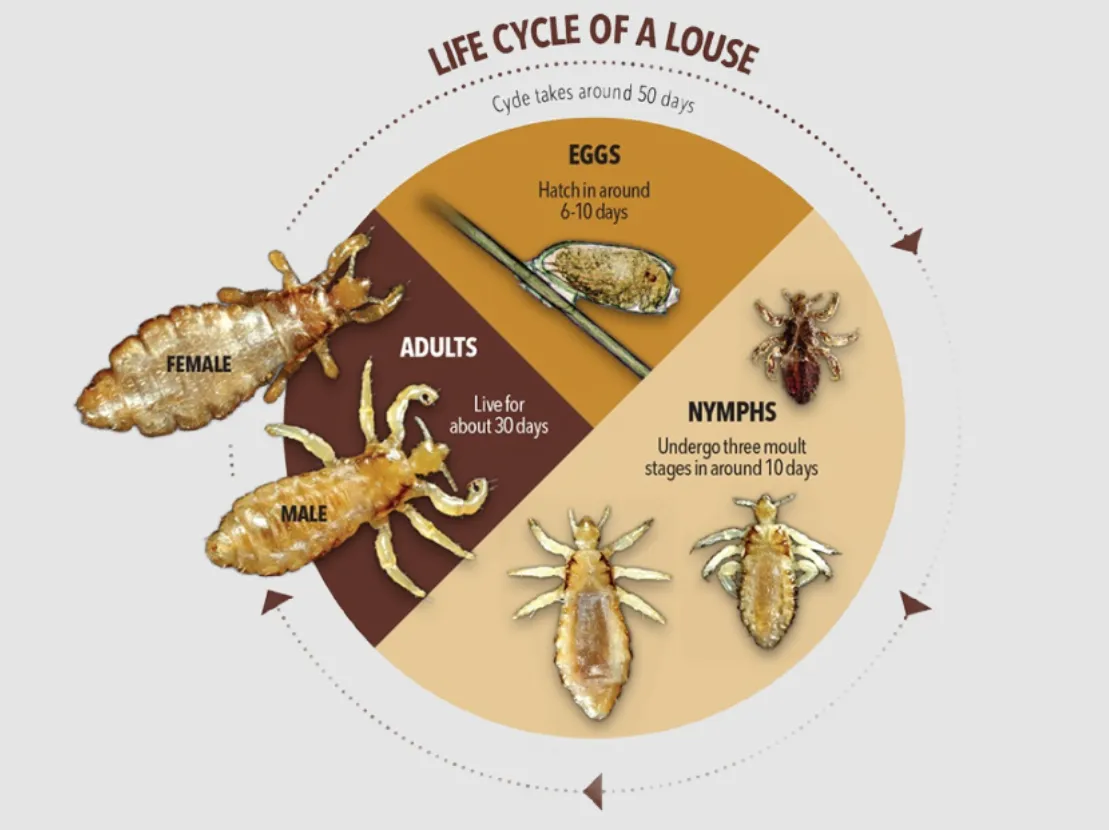
A complete infestation usually begins when a fertilized adult female reaches the hair. She lays head lice eggs, also called nits, near the scalp where warmth helps them develop. Eggs usually hatch in about 6–9 days, nymphs mature after several molts, and adults can live up to about 30 days on the head if they keep feeding.
Q: How many stages are in the life cycle of head lice?
A: The basic life cycle has three biological stages: egg, nymph, and adult. For easier learning, nymph development is often divided into early, middle, and late nymphal stages.
Q: How long do head lice live on a human head?
A: Adult head lice can live up to about 30 days on a person’s head when they can feed on blood. Away from the human host, they usually die within 1–2 days.
Q: Do head lice mean poor hygiene?
A: No. Getting a head lice infestation is not related to cleanliness. The most common spread is direct head-to-head contact.
Important Things That You Need To Know
Understanding the life cycle of head lice is important because treatment timing depends on when eggs hatch and when young lice become adults. Many people fail at head lice treatment because they kill crawling lice but miss eggs that hatch later. This is why some products need a second treatment about a week later, depending on the medicine instructions.
The term head lice pictures usually refers to visual guides showing eggs, nymphs, and adults. Eggs look like tiny oval capsules glued to hair shafts, often close to the scalp. They can be mistaken for dandruff, hair spray flakes, or dirt, but true nits are firmly attached and do not brush away easily.
A real head lice infestation is best confirmed by finding a live nymph or adult louse. Nits within about ¼ inch or 6 mm of the scalp are more suggestive of active infestation than nits farther away, which are often old, empty, or dead.
For treating head lice, public health guidance recommends checking household members, treating infested people and their bed-sharing contacts simultaneously, following label instructions, and avoiding unsafe home remedies. The CDC also states that animals do not get or spread human head lice.
Quick Life Cycle Table
| Stage | What It Looks Like | Time Frame | Key SEO Fact |
| Egg / Nit | Tiny oval egg glued near scalp | 6–9 days to hatch | Head lice eggs need scalp warmth |
| Young Nymph | Pinhead-sized baby louse | Starts after hatching | Must feed on blood |
| Growing Nymph | Looks like a small adult | About 7 days to mature | Molts three times |
| Adult Louse | Sesame-seed-sized, 6 legs | Up to 30 days on head | A female lays several eggs daily |
The History of Their Scientific Naming, Evolution, and Origin
Scientific Naming
The accepted scientific name for the human head louse is Pediculus humanus capitis. NCBI lists it as a subspecies with the common name human head louse, and also records Pediculus capitis as a synonym.
Taxonomic Position
Head lice belong to the insect group Phthiraptera, the sucking lice group Anoplura, and the family Pediculidae. They are closely related to body lice, which are usually classified as Pediculus humanus humanus.
Evolution And Origin
Head lice have a long evolutionary relationship with humans and other primates. Research on primate lice suggests sucking lice have coevolved with primate hosts for at least 25 million years, while human head/body lice and chimpanzee lice diverged roughly around the time their hosts diverged.
Human History Connection
Genetic studies show that Pediculus humanus has multiple ancient lineages. This makes head lice useful in studying human movement, ancient contact, and parasite evolution.

Their Reproductive Process, Giving Birth And Rising Their Children
They Lay Eggs, Not Live Babies
Head lice do not give birth like mammals. A female louse lays eggs called nits and attaches them to hair shafts with a cement-like substance near the scalp. This placement keeps the eggs warm enough to develop.
Female Egg Production
Adult females are usually larger than males and may lay up to about 8 eggs per day, according to CDC DPDx. Other clinical sources describe similar daily egg-laying ranges, which explains why a small infestation can grow quickly if not treated correctly.
Egg Protection
The eggshell protects the developing embryo. Once the nymph hatches, the empty nit case may remain attached to the hair, which is why people may still see white or pale shells after successful treatment.
No Parental Care
Head lice do not “raise” their young. After hatching, nymphs immediately begin living like small adults. They crawl, stay close to the scalp, and must feed on blood to survive.
Why Timing Matters
Because eggs hatch days after being laid, head lice treatment must match the life cycle. Products that do not kill eggs often require retreatment after eggs hatch but before new adults can lay more eggs.
Stages of the Head Lice Life Cycle
Stage 1: Egg Or Nit
The first stage is the head lice egg, commonly called a nit. A female attaches each egg near the scalp, often behind the ears or near the nape of the neck. Viable eggs are usually close to the scalp because they need warmth. CDC DPDx describes nits as about 0.8 mm by 0.3 mm, oval, and usually yellow to white.
Stage 2: Newly Hatched Nymph
After about 6–9 days, the egg hatches, and a tiny nymph emerges. This nymph looks like a miniature adult but is much smaller, around the size of a pinhead. It must feed on blood to live and develop.
Stage 3: Growing Nymph Instars
Nymphs pass through three molts before becoming adults. This means they shed their outer covering as they grow. The full nymph stage usually takes about 7 days after hatching, although timing can vary with conditions.
Stage 4: Adult Head Louse
The adult louse has six clawed legs adapted to grip hair. It feeds several times daily and can live up to 30 days on a human head. Adult females continue the cycle by laying eggs near the scalp. Without blood meals, adult lice usually die within 1–2 days away from the host.
Their Main Diet, Food Sources, And Collection Process Explained
The main diet of head lice is human blood. They are ectoparasites, meaning they live on the outside of the host’s body while feeding on it. Both nymphs and adults need blood meals to survive.
Primary Food Source
Their only known host is humans. They do not feed on pets, furniture, dust, or dead skin. This is why animals do not spread human head lice infestation.
How They Feed
Head lice use specialized mouthparts to pierce the scalp and take tiny blood meals. Their saliva can trigger an allergic reaction, which causes itching in many people. First-time itching may take 4–6 weeks to appear.
How They Collect Food
They stay close to the scalp because warmth, blood access, and hair grip are essential for survival. Their claws help them hold onto hair while feeding and moving.
Why They Cannot Live Long Away From Humans
Away from the scalp, they lose access to blood and warmth. Adult lice usually die within 1–2 days off the host, and eggs usually do not hatch if they are not kept near scalp-level temperature.

How Long Do Head Lice Live
- On the human head: Adult head lice can live up to about 30 days when they have regular blood meals. During this time, females can lay eggs and keep the infestation active.
- As an egg: The nit stage usually lasts about 6–9 days before hatching. Eggs farther from the scalp are less likely to be viable because they may not receive enough warmth.
- As a nymph: Nymphs mature after three molts and become adults about 7 days after hatching. This short development period is why delayed treatment can allow a new generation to start.
- Away from a person: Adult lice usually die within 1–2 days if they fall off and cannot feed. This is why deep house fumigation is unnecessary and potentially unsafe.
- On bedding or furniture: The risk of getting lice from carpets, couches, or furniture is considered very small. Washing recently used bedding and clothing is useful, but excessive cleaning is not needed.
- Without proper treatment, a colony may persist as long as adult females survive, eggs hatch, and close contacts allow reinfestation. This is why checking household members and treating confirmed cases simultaneously matters.
- After treatment: Seeing old nits does not always mean active lice. Successful treatment kills crawling lice, while empty nit shells may remain attached to hair until removed or grown out.
Head Lice Lifespan in the Wild vs. in Captivity
In The Wild
For head lice, “wild” means living naturally on a human scalp. They are not free-living insects in soil, grass, or bedding. On a human head, adults can survive up to about 30 days, feed several times daily, and reproduce if male and female lice are present.
Away From The Host
Off the scalp, their lifespan becomes very short. Adult lice usually die within 1–2 days without blood meals, and nits usually fail to hatch if they are away from scalp warmth.
In Captivity Or Laboratory Conditions
In research settings, lice may be studied under controlled conditions of warmth and feeding. However, ordinary homes do not provide true “captivity” conditions, as head lice need human blood and a warm body temperature.
Key Difference
The main difference is access to the host. Humans can complete the life cycle of head lice. Away from humans, survival drops quickly, which is why human-to-human contact is the main route of transmission.
Importance of Head Lice In This Ecosystem
Part Of Parasite Biodiversity
Although head lice are unwanted parasites, they are still part of biological diversity. They show how specialized parasites evolve with their hosts over long periods.
A Tool For Evolutionary Science
Head lice help researchers study human history, migration, and host-parasite coevolution. Genetic research has found multiple lineages of Pediculus humanus, including ancient splits that may reflect human and archaic hominin history.
A Public Health Teaching Model
The life cycle of head lice is useful for teaching why treatment timing matters. It shows how eggs, nymphs, and adults respond differently to medicines and combing.
A Reminder About Safe Pest Control
Head lice also remind people that pest control should be targeted. Public health sources warn against fumigant sprays and fogs because they are unnecessary for head lice and can be toxic.
Human Impact
They do not spread disease as body lice can, but they can cause itching, sleep disturbance, stress, and secondary skin infection from scratching.
What To Do To Protect Them In Nature And Save The System For The Future
Because head lice are human parasites, the goal is not to protect people from infestations. The responsible goal is to manage them safely while protecting the wider environment.
Use Targeted Treatment Only
- Treat confirmed head lice infestation, not random itching or old nits alone. Misdiagnosis can lead to unnecessary insecticide use.
Avoid Toxic Sprays And Foggers
- Do not use fumigant sprays or fogs for head lice. They are not necessary and may be harmful if inhaled or absorbed through the skin.
Follow Label Directions
- Use head lice treatment exactly as directed. Overusing products can increase irritation and may contribute to treatment failure.
Choose Safer Cleaning Habits
- Wash recently used bedding, clothing, and towels in hot water when appropriate, but avoid excessive chemical cleaning. Public health guidance says the furniture transmission risk is very small.
Support Research, Not Infestation
- Preserve knowledge through scientific study, museum specimens, and public health education rather than allowing untreated infestations to spread.

Fun & Interesting Facts About Head Lice
- Head lice cannot jump, fly, or hop. They spread mainly by crawling during direct hair-to-hair contact.
- A nit is not loose like dandruff. It is glued to the hair shaft with a strong, cement-like substance.
- Adult lice are roughly the size of a sesame seed, but nymphs can be as tiny as a pinhead.
- Lice are highly host-specific. Human head lice need humans; pets do not get or spread them.
- Itching is not always immediate. With a first infestation, itching may take 4–6 weeks to appear.
- Old nits can stay attached after the infestation is gone, so finding nits alone does not always prove active lice.
- Head lice have helped scientists study human evolution, migration, and ancient host-parasite relationships.
- Clean hair and dirty hair can both get lice. Infestation is about contact, not hygiene.
Frequently Asked Questions (FAQs)
Q: What is the full life cycle of head lice?
A: The full life cycle of head lice includes egg, nymph, and adult stages. Eggs hatch in about 6–9 days, nymphs mature after several molts, and adults can live up to about 30 days on the scalp.
Q: What do head lice eggs look like?
A: Head lice eggs are tiny oval capsules attached firmly to hair shafts near the scalp. They may appear yellow, tan, or white and are often mistaken for dandruff.
Q: What is the best way of treating head lice?
A: The best approach is to confirm active infestation, use an approved over-the-counter or prescription head lice treatment as directed, remove lice and nits with a fine comb when recommended, and check close contacts.
Q: Can head lice survive in pillows and bedding?
A: They can fall onto bedding, but they do not survive long without feeding. Washing items used in the two days before treatment and avoiding over-cleaning is usually enough.
Q: Do children with head lice need to leave school immediately?
A: CDC guidance says children with head lice do not need to be sent home early. They can finish the school day, begin appropriate treatment at home, and return after treatment starts.
Final Word
The life cycle of head lice is simple but powerful: egg, nymph, and adult stages repeat quickly when lice remain close to the scalp. Knowing this cycle helps parents, caregivers, teachers, and health writers understand why eggs are hard to remove, why nymphs appear after treatment, and why timing matters in treating head lice.
The most important lesson is that head lice infestation is not a sign of poor hygiene. It is usually spread through close head-to-head contact, especially among children. A calm, accurate response works better than panic, shame, or harsh chemicals.
For the best results, confirm active lice, follow approved treatment instructions, comb carefully when needed, check close contacts, and avoid unsafe home remedies or fumigation. With the right knowledge, the life cycle can be interrupted safely and effectively.
Also Read: bunny life cycle
About the Author