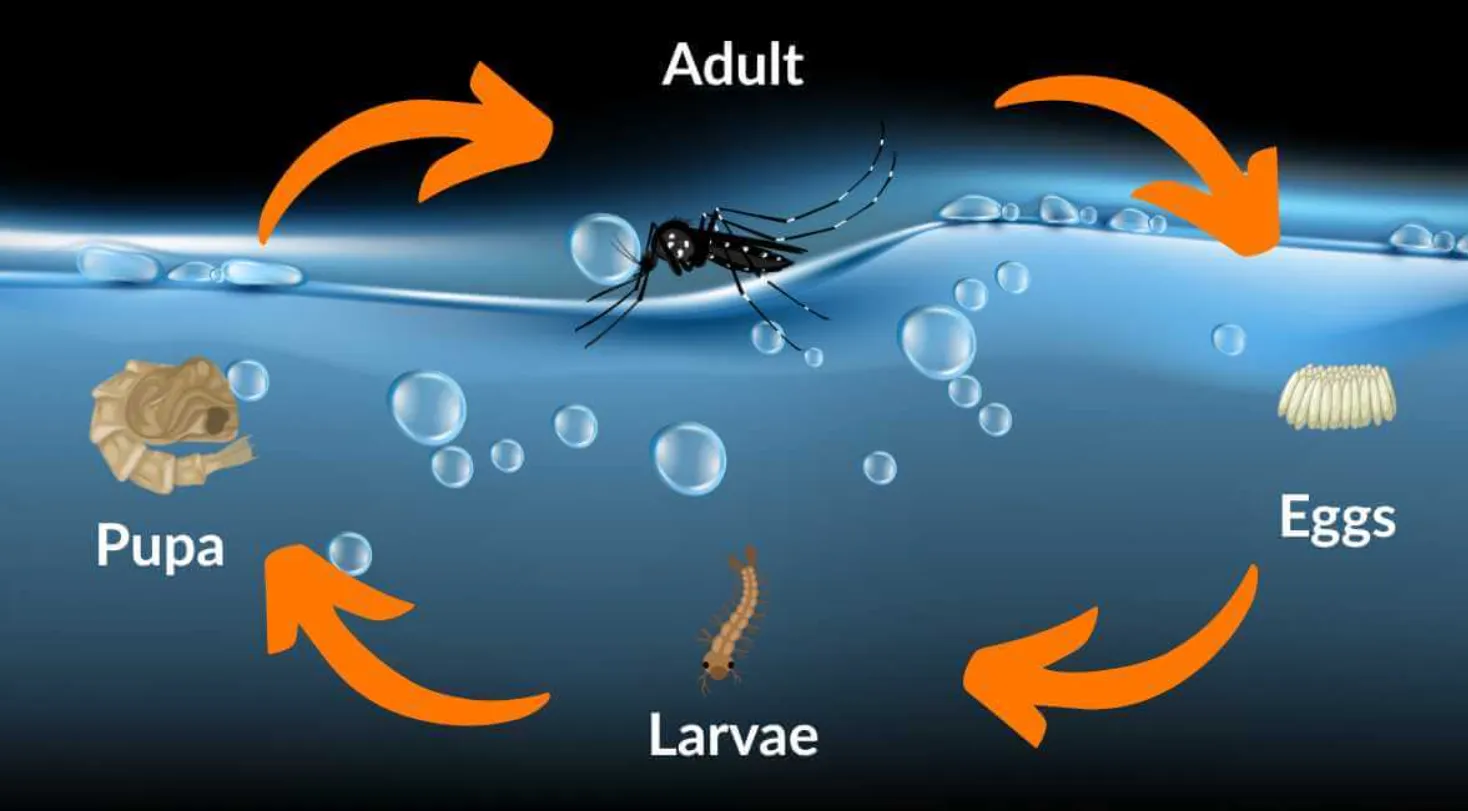
The life cycle of a mosquito is the complete journey from egg to adult. Mosquitoes pass through four main stages: egg, larva, pupa, and adult. This process is called complete metamorphosis because the young mosquito looks very different from the adult flying insect.
Most mosquitoes need standing water to complete their life cycle. Even a small amount of water in a flowerpot, bucket, tire, drain, birdbath, or bottle cap can become a breeding place. Depending on the species, temperature, and environment, a mosquito can grow from egg to adult in about a week or slightly longer.
Mosquitoes are often known for mosquito bites, but only female mosquitoes bite humans and animals. They need blood mainly to produce eggs. Male mosquitoes usually feed on nectar and plant juices.
Mosquitoes are also important in public health because some species can spread diseases such as malaria, dengue, Zika, chikungunya, yellow fever, and West Nile virus. Understanding the mosquito life cycle helps people improve mosquito control, reduce breeding sites, and protect families from bites.
Q: What are the four stages of the life cycle of a mosquito?
A: The four stages are egg, larva, pupa, and adult.
Q: How fast can mosquitoes grow from egg to adult?
A: In warm conditions, many mosquitoes can complete development in about 7–10 days, though timing depends on species and environment.
Q: Why do mosquitoes bite humans?
A: Female mosquitoes bite because they need blood protein to develop eggs. Male mosquitoes do not bite.
Quick Life Cycle Table
| Stage | Where It Happens | What Happens | Main Risk |
| Egg | On or near water | Females lay eggs singly or in groups | Standing water starts breeding |
| Larva | Water | Larvae feed and grow | Best stage for mosquito control |
| Pupa | Water | Mosquito transforms into an adult | No feeding, but still active |
| Adult | Air, plants, homes | Adult flies mate and feed | A female may bite and spread disease |
The History Of Their Scientific Naming, Evolution, and Origin
Scientific Naming of Mosquitoes
Mosquitoes belong to the family Culicidae under the order Diptera, which means “two-winged flies.” The word mosquito comes from Spanish and Portuguese, meaning “little fly.” This name fits their small body size, thin legs, wings, and long mouthpart called a proboscis.
Evolution of Mosquitoes
Mosquitoes are ancient insects. Scientific studies suggest that the mosquito family evolved millions of years ago, likely in wetland environments where water, plants, and animal hosts were available. Their life cycle became closely linked with water because eggs, larvae, and pupae all depend on aquatic habitats.
Origin and Early Adaptation
Early mosquitoes likely lived around wetlands and fed on plant fluids. Over time, female mosquitoes evolved blood-feeding behavior because blood provides protein needed for egg production. This adaptation helped mosquitoes spread across many habitats, from forests and wetlands to cities and villages.

Their Reproductive Process, Giving Birth, And Rising Their Children
Mosquitoes Do Not Give Birth Like Mammals
Mosquitoes do not give birth to live babies. Instead, female mosquitoes lay eggs. These eggs hatch into larvae when conditions are right, usually when they come into contact with water.
Mating Process
Adult male mosquitoes usually emerge first and wait near breeding areas. They locate females by detecting wingbeat frequency and movement. After mating, the female stores sperm and can use it to fertilize several batches of eggs.
Blood Meal and Egg Production
Female mosquitoes usually need a blood meal before laying eggs. Blood contains protein and nutrients that help eggs develop. After feeding, the female rests while the eggs mature inside her body.
Egg Laying
Different mosquito species lay eggs differently. Some lay eggs directly on water. Others lay eggs on damp surfaces near water, where they hatch later after flooding or rainfall.
No Parental Care
Mosquitoes do not raise their young. Once eggs are laid, the female leaves them. Larvae survive by feeding on microorganisms, algae, bacteria, and organic matter in water. Their “childhood” happens independently in the water.
Stages Of Life Mosquito Cycle
Egg Stage
The egg stage begins when a female mosquito lays eggs in or near water. Some mosquitoes lay single eggs, while others lay floating egg rafts. Eggs may hatch quickly in warm water, but some can survive dry conditions for a time and hatch later when water returns.
This is why empty containers around homes can suddenly produce mosquitoes after rain.
Larva Stage
The larva stage is the active feeding stage. Mosquito larvae live in water and are often called “wrigglers” because of their movement. They feed on tiny organic particles, bacteria, and algae.
Larvae come to the water surface to breathe. This stage is very important for mosquito control, because removing standing water or using safe larval-control methods can stop mosquitoes before they become biting adults.
Pupa Stage
The pupa stage is a transformation stage. Mosquito pupae live in water but usually do not feed. They are sometimes called “tumblers” because they move quickly when disturbed.
Inside the pupa, the mosquito changes into an adult. After development is complete, the adult mosquito emerges from the pupal skin and rests briefly before flying away.
Adult Stage
The adult mosquito is the flying stage. Males usually feed on nectar and plant fluids. Females also feed on plant sugars, but many species need blood to produce eggs.
Adult females search for hosts by detecting body heat, carbon dioxide, odor, and moisture. After feeding, they lay eggs and repeat the cycle.
Their Main Diet, Food Sources, And Collection Process Explained
Male Mosquito Diet
Male mosquitoes mainly eat nectar, plant sap, and other sugary plant fluids. They do not bite humans or animals. Their main goal is to survive long enough to mate.
Female Mosquito Diet
Female mosquitoes also feed on nectar for energy. However, many female mosquitoes need blood to produce eggs. Blood gives them protein, iron, and other nutrients required for egg development.
Larval Food Sources
Mosquito larvae feed in water. Their diet includes:
- Algae
- Bacteria
- Microorganisms
- Decaying plant matter
- Tiny organic particles
How Mosquitoes Find Food
Adult female mosquitoes use several signals to find hosts. They can detect carbon dioxide from breathing, body heat, sweat odor, and skin chemicals. This is why some people may get more mosquito bites than others.
Feeding and Survival
Mosquito feeding is strongly connected to survival and reproduction. Sugar meals give energy, while blood meals help egg production. Without water, eggs and larvae cannot complete the life cycle.
Important Things That You Need To Know
Understanding the mosquito life cycle is useful for health, gardening, home safety, and outdoor living. Many people only notice adult mosquitoes after they bite, but the real control point starts much earlier in the water.
Mosquito control works best when breeding places are removed. Empty buckets, blocked drains, plant saucers, roof gutters, unused tires, and open tanks should be checked often. Even clean water can support larvae if it remains still.
For personal protection, mosquito repellent can reduce bites when used correctly. Repellents are especially useful during dawn, dusk, and nighttime, depending on the mosquito species. Long sleeves, window screens, mosquito nets, and fans can also help reduce contact.
Mosquito dunks are commonly used in standing water that cannot be emptied, such as ponds, rain barrels, or drainage areas. Many mosquito dunks use Bti, a biological larvicide that targets mosquito larvae in water.
The term mosquito hawk can be confusing. In many places, people use it for crane flies or dragonflies. Crane flies look like giant mosquitoes but usually do not bite. Dragonflies, however, can eat mosquitoes and are natural predators.
People searching for mosquito control near me should look for services that focus on source reduction, larval control, safe application, and inspection of breeding sites—not only spraying adult mosquitoes.

How Long Does A Mosquito Live
- Mosquito lifespan depends on the species. Some mosquitoes live only a few days, while others can survive several weeks.
- Male mosquitoes usually live shorter lives. Many males live for about 1 week, mainly feeding on nectar and mating.
- Female mosquitoes often live longer than males. Female mosquitoes may live two weeks to a month, and some can survive longer in protected conditions.
- Temperature affects lifespan. Warm weather speeds up development, but extreme heat can reduce survival.
- Water availability controls the early life cycle. Eggs, larvae, and pupae need water or moisture to develop.
- Food access matters. Adults need sugar sources such as nectar. Females also need blood meals for egg production.
- Predators reduce survival. Fish, dragonfly larvae, frogs, bats, birds, spiders, and other insects can eat mosquitoes.
- Human control reduces lifespan. Removing standing water, using larvicides, screens, and repellents, lowers mosquito survival around homes.
- Indoor shelter may extend survival. Mosquitoes protected from wind, dryness, and predators may live longer.
- Dry-resistant eggs can survive harsh periods. Some mosquito eggs can wait until water returns, allowing the life cycle to restart after rain.
In simple terms, the adult mosquito may not live very long, but its life cycle is fast. That speed is why mosquito populations can grow quickly after rainfall.
Mosquito Lifespan in the Wild vs. in Captivity
Mosquito Lifespan in the Wild
In the wild, mosquitoes face many threats. Predators, rain, wind, heat, drought, and food shortages can shorten their lives. Many mosquitoes die before completing reproduction.
Wild female mosquitoes may live long enough to take blood meals and lay several batches of eggs, but survival is never guaranteed.
Mosquito Lifespan in Captivity
In laboratory or controlled conditions, mosquitoes may live longer because temperature, humidity, food, and safety are managed. Researchers often keep mosquitoes in cages with sugar solution and controlled humidity.
Captive mosquitoes are used in scientific studies to understand disease transmission, insecticide resistance, genetics, and mosquito behavior.
Main Difference
The biggest difference is stress. Wild mosquitoes face predators and weather changes, while captive mosquitoes live in stable conditions. Because of this, laboratory mosquitoes can sometimes survive longer than mosquitoes outdoors.
Importance of Mosquitoes in This Ecosystem
Food for Other Animals
Mosquitoes are food for many animals. Fish eat larvae, while birds, bats, frogs, spiders, dragonflies, and other insects may eat adults. In wetland ecosystems, mosquito larvae can be part of the aquatic food chain.
Nutrient Recycling
Mosquito larvae feed on organic matter in water. By consuming microorganisms and decaying materials, they help move nutrients through aquatic systems.
Pollination Role
Although mosquitoes are known for biting, many adult mosquitoes feed on nectar. In some environments, they may help pollinate certain plants while feeding.
Scientific Importance
Mosquitoes are important in medical research because they help scientists study disease transmission, public health, genetics, climate effects, and vector control.
Balanced View
Mosquitoes have ecological roles, but disease-spreading species must be managed carefully. The goal is not careless destruction of nature, but smart control that protects human health and keeps ecosystems balanced.
What To Do To Protect Them In Nature And Save The System For The Future
Protect Natural Wetlands Carefully
- Wetlands support many species, not only mosquitoes.
- Protecting wetlands helps fish, birds, frogs, insects, and plants survive.
- Control should focus on disease-risk areas rather than destroying entire habitats.
Encourage Natural Predators
- Dragonflies, fish, bats, birds, and frogs can naturally reduce mosquito numbers.
- Avoid unnecessary pesticide use that harms helpful insects.
Use Targeted Mosquito Control
- Use larval control in specific breeding sites.
- Avoid broad spraying unless necessary.
- Choose safer, science-based control methods.
Remove Artificial Breeding Sites
- Empty containers around homes.
- Clean gutters and drains.
- Cover water tanks.
- Change the birdbath and pet water regularly.
Support Public Health Education
- Teach communities about mosquito life stages.
- Explain how mosquito bites happen.
- Promote responsible use of mosquito repellent and safe water management.

Fun & Interesting Facts About Mosquito
- Only female mosquitoes bite humans and animals.
- Male mosquitoes usually feed on nectar and plant sugars.
- Mosquitoes can detect carbon dioxide from human breathing.
- Some mosquito eggs can survive dry conditions and hatch later after rain.
- Mosquito larvae are aquatic, but adult mosquitoes are flying insects.
- A tiny amount of standing water can support mosquito breeding.
- Dragonflies are sometimes called natural mosquito predators.
- The word mosquito means “little fly.”
- Mosquitoes belong to the insect order Diptera, meaning two-winged flies.
- Not every mosquito species spreads disease.
- Some mosquitoes prefer birds, some prefer mammals, and some bite humans more often.
- Fans can help reduce mosquito bites because mosquitoes are weak flyers.
Frequently Asked Questions (FAQs)
Q: What is the life cycle of a mosquito?
A: The life mosquito cycle is the process mosquitoes go through from egg to larva, pupa, and adult.
Q: Where do mosquitoes lay eggs?
A: Mosquitoes lay eggs in water, on water, or near places that may later become wet.
Q: How can I stop mosquito breeding at home?
A: Remove standing water, clean drains, cover tanks, use screens, and manage water containers properly.
Q: Do mosquito bites always spread disease?
A: No. Not every mosquito carries disease. However, some species can spread germs, so bite prevention is important.
Q: Are mosquito dunks useful?
A: Yes, mosquito dunks can help control larvae in standing water that cannot be removed, especially when they contain Bti and are used according to label directions.
Final Word
The mosquito’s life cycle is simple but powerful. A mosquito begins as an egg, grows as a larva, transforms as a pupa, and becomes an adult flying insect. Because this cycle depends heavily on water, controlling standing water is the most effective way to reduce mosquitoes around homes and communities.
Mosquitoes are part of nature, but some species create serious health risks through mosquito bites. Smart prevention means understanding both sides: their ecological role and their public health impact.
By removing breeding sites, using safe mosquito control, applying mosquito repellent correctly, and supporting natural predators, people can reduce mosquito problems without damaging the wider ecosystem. The more we understand the mosquito life cycle, the better we can protect our families, gardens, neighborhoods, and environment.
Also Read: house fly life cycle
About the Author